





A Tale of Two Orbits
One of the most reliable ways to tell a natural object from an artificial one is by its path through space. Natural objects like asteroids and meteoroids follow orbits dictated purely by the gravitational pull of the Sun, planets, and other large celestial
bodies. Their paths are often elliptical and can be highly inclined relative to the plane of the planets. In contrast, artificial objects—defunct satellites, rocket boosters, or fragments from collisions—tend to follow more predictable paths. Many were intentionally placed in specific Earth orbits, like low-Earth orbit (LEO) or geosynchronous orbit (GEO), which have characteristic altitudes and speeds. An object found in one of these highly trafficked orbital highways is much more likely to be human-made. Furthermore, natural objects entering our solar system from interstellar space have hyperbolic trajectories, meaning they are moving too fast to be captured by the Sun's gravity and will eventually fly back out into deep space.
It's All in the Shine
Another key clue is how an object reflects sunlight, a property known as albedo. Natural space rocks, or meteoroids, are often dark, with surfaces weathered by billions of years of radiation. A typical comet nucleus, for example, might have a very low albedo, reflecting only about 4% of the light that hits it. In contrast, artificial objects are often made of highly reflective materials like polished metals, aluminum alloys, and specialized paints. These materials give them a higher albedo, making them appear brighter than a similarly sized natural object. By measuring the brightness and how it changes over time, astronomers can make an educated guess about an object's surface composition. An unusually high reflectivity for a small object is often a red flag that it’s not a space rock.
Decoding the Light
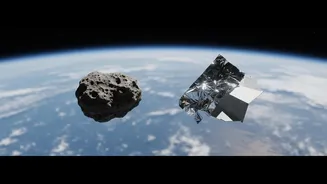
For a more definitive answer, scientists turn to spectroscopy. This technique involves breaking down the light reflected from an object into its constituent colors, creating a spectrum. This spectrum acts like a chemical fingerprint, revealing what the object is made of. Rocky asteroids have spectra that show the presence of silicates and other minerals. Man-made objects, on the other hand, have spectra that can reveal the signatures of materials that don't typically occur in space rocks, such as stainless steel or specific types of paint and polymers like polyvinyl fluoride. In one famous case, an object designated 2020 SO was initially thought to be an asteroid. However, spectral analysis later confirmed it was actually the Centaur-D rocket booster from NASA’s 1966 Surveyor 2 mission to the Moon.
Speed, Shape, and Behavior
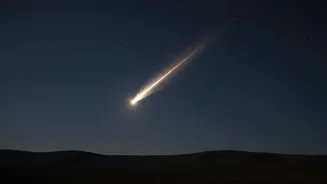
Velocity provides another critical piece of the puzzle. Objects in low-Earth orbit travel at around 17,000 miles per hour to avoid falling back to Earth. Meteors entering the atmosphere are often moving much faster relative to the planet. Additionally, some lightweight artificial objects can be subtly pushed around by the pressure of sunlight itself, a phenomenon called solar radiation pressure. This can cause their orbits to change in ways that would be unusual for a dense, natural rock. While it's harder to determine an object's exact shape from afar, its light curve—the pattern of how its brightness changes as it tumbles—can offer hints. Regular, repeating patterns might suggest an artificially constructed shape, whereas the irregular tumbling of a space rock often produces a more chaotic light curve.
Why the Distinction Matters
Distinguishing between natural and artificial objects is not just an academic exercise. Organizations like NASA's Center for Near-Earth Object Studies (CNEOS) track thousands of objects to assess any potential impact risk to Earth. Mistaking a harmless piece of space junk for a potentially hazardous asteroid could cause unnecessary panic, while misidentifying a dangerous asteroid could have catastrophic consequences. Moreover, the growing cloud of space debris poses a significant threat to active satellites that we rely on for communication, navigation, and scientific research. Correctly identifying each piece of this celestial clutter is essential for managing orbital traffic and ensuring the safety of future space missions.