




A Murky View of the Past
Before the James Webb Space Telescope (JWST), peering back to the universe's infancy was an immense challenge. Telescopes like Hubble gave us tantalizing glimpses, but they were fundamentally limited. Visible light from the very first stars and galaxies
has been traveling for over 13 billion years, and during that journey, the expansion of the universe stretches it into infrared light—a phenomenon called redshift. Hubble is not optimized to see deep into the infrared. Furthermore, the early universe was filled with vast clouds of cosmic dust that act like a celestial fog, blocking visible light and obscuring the view. For astronomers, this meant that the most ancient galaxies often appeared as faint, indistinct smudges, if they could be seen at all. Gathering detailed information was a painstakingly slow process, often requiring hundreds of hours of observation time just to analyze a single object.
Webb’s Infrared Revolution
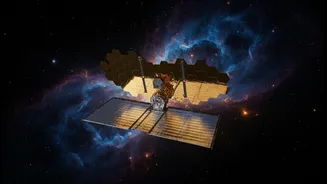
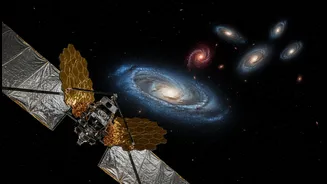
The JWST was engineered specifically to overcome these challenges. Its massive 6.5-meter primary mirror, coated in a micro-thin layer of gold, is designed to be exquisitely sensitive to the near- and mid-infrared light from the cosmic dawn. This allows it to capture the faint, redshifted signals from the universe's first luminous objects. Unlike Hubble, Webb can see through the dense dust clouds, revealing the galactic nurseries hidden within. This technical prowess means it can detect objects up to 100 times fainter than Hubble could, transforming our ability to even find these ancient structures in the first place. The telescope's location, orbiting the sun a million miles from Earth, also keeps it incredibly cold, which is essential for preventing its own heat from interfering with the faint infrared signals it’s trying to detect.
The Efficiency Engine
Perhaps the biggest leap forward in making this exploration 'easier' comes from an instrument called the Near-Infrared Spectrograph, or NIRSpec. In the past, analyzing a galaxy's light to determine its chemical composition, distance, and temperature—a process called spectroscopy—was a one-at-a-time affair. NIRSpec features a revolutionary piece of technology: a microshutter array. This grid of a quarter-million tiny shutters, each smaller than a human hair, can be opened or closed to simultaneously capture the spectra of over 100 different objects in a single observation. This has turned a huge bottleneck in astronomical research into a high-throughput process, allowing scientists to build large catalogues of early galaxies with detailed information far more rapidly than was ever thought possible. This leap in efficiency is what truly accelerates the pace of discovery.
From Faint Smudges to Cosmic Structures
With this newfound ease of observation, scientists are no longer just counting faint dots. The quality of data from Webb is so high that it is revealing the actual shapes of galaxies in the early universe, which were often far from the grand spirals we see today. Early research shows many were flat and elongated, whimsically described as looking like "surfboards and pool noodles." In July 2026, researchers using Webb data shed new light on why some galaxies from 9 billion years ago suddenly stopped forming stars, finding subtle signs of violent past mergers that were previously invisible. Webb is providing a flood of data that is not only confirming theories but also creating new puzzles. Recent observations have revealed a menagerie of unexpected objects, including galaxies that appear far too bright and mature for their age and mysterious "little red dots" that might be a completely new type of object—perhaps supermassive black holes wrapped in a dense cocoon of gas.