



Sailing on Sunlight: A New Kind of Engine
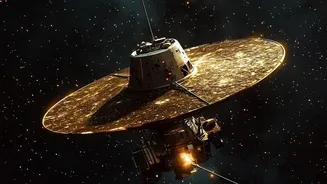
Imagine a boat on the ocean, its sails catching the wind to move it forward. A solar sail works on a similar principle, but in the vacuum of space. Instead of wind, it catches the constant stream of photons—particles of light—flowing from the sun. Each
photon imparts a tiny push, and over time, this gentle but continuous pressure on a large, reflective sail can accelerate a spacecraft to incredible speeds without using a single drop of propellant. This is a game-changer. Traditional rockets are limited by the amount of fuel they can carry, which makes missions expensive and constrains their destinations. Solar sails, on the other hand, use an endlessly available resource, allowing for longer, more complex missions that were previously impossible.
The Breakthrough: Smaller, Lighter, and Smarter
The latest milestones are not just about building bigger sails, but also about making them smarter and more efficient for smaller spacecraft. Innovations in lightweight, durable materials like aluminized polyimide and advanced composite structures are key. For instance, NASA's NEA Scout mission, although ultimately unsuccessful in establishing contact, was a pioneering attempt to use a 6U CubeSat—roughly the size of a shoebox—with a solar sail to visit a near-earth asteroid. The design itself, involving an 86-square-meter sail deploying from such a compact probe, represented a significant engineering feat. Furthermore, researchers are developing new 'coilable stacked' solar sails and advanced photonic materials that promise even greater efficiency and control for future lightweight missions.
Why We Study Near-Earth Asteroids
Near-Earth Asteroids (NEAs) are more than just space rocks; they are time capsules from the birth of our solar system. Studying them up close provides invaluable clues about planetary formation and the origins of water and life on Earth. But there are more practical reasons, too. NEAs represent a potential future source of valuable minerals and water, which could be used for in-space manufacturing and sustaining long-term human missions. Perhaps most critically, tracking and understanding these asteroids is vital for planetary defense. While a major impact is a low-probability event, the consequences would be catastrophic, making missions that study their composition and trajectory essential for developing mitigation strategies.
A New Chapter in Space Exploration
The combination of lightweight probes and solar sail propulsion opens the door to an entirely new model of exploration. Instead of single, monolithic missions, space agencies can envision launching fleets of small, relatively inexpensive probes. These could visit multiple asteroids, creating a comprehensive map of our cosmic neighborhood. This technology could dramatically shorten travel times across the solar system; a trip to the outer planets that currently takes years could be reduced to months. Agencies like NASA and ESA are actively investing in these technologies, not just for asteroid science but for future deep-space observatories and planetary defense systems.
What's on the Horizon?
The journey is just beginning. While missions like NEA Scout have faced challenges, the lessons learned are fueling the next generation of solar sail craft. NASA's Innovative Advanced Concepts (NIAC) program recently funded studies into even more advanced designs, such as 'Coilable Stacked Solar Sails' for high-speed missions. Other concepts, like the Solar Cruiser, aim to use much larger sails—covering an area equivalent to four basketball courts—to place scientific instruments in unique orbits for better space weather prediction. As materials science and autonomous navigation improve, these futuristic sails will become an indispensable tool, potentially enabling missions to intercept interstellar objects or even, one day, venture to other stars.