






In the vast cosmic theater, some objects defy easy categorization. They aren't quite stars, but they're too massive to be planets. A new study, leveraging NASA's powerful SPHEREx telescope, is now peeling back the mysteries of these in-between worlds.
Meet the 'Failed Stars' of the Cosmos
Imagine an object that forms from a collapsing cloud of gas and dust, just like a star. It gathers mass, its core heats up, but it just misses the mark. It never becomes dense and hot enough to ignite the stable, sustained hydrogen fusion that makes stars shine. This is a brown dwarf. Often called 'failed stars', these objects occupy a fascinating middle ground, with masses somewhere between 13 and 80 times that of Jupiter. They are too big to be considered planets, but too small to be stars. In their youth, they glow with leftover heat from their formation, but over billions of years, they slowly cool, dim, and fade, eventually emitting light only in the infrared spectrum, which is invisible to the human eye.
SPHEREx: A New Eye on the Infrared Sky
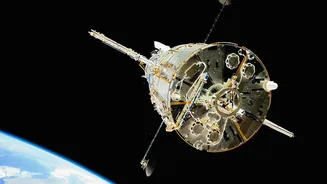
Detecting these dim, lonely wanderers has always been a challenge for astronomers. This is where NASA's SPHEREx (Spectro-Photometer for the History of the Universe, Epoch of Reionization, and Ices Explorer) comes in. Launched in 2025, this space telescope is on a mission to map the entire sky in near-infrared light, creating a comprehensive 3D map of the universe. While its primary goals include studying the origins of the universe and galaxies, SPHEREx is uniquely suited to hunt for brown dwarfs. By surveying the sky in 102 different infrared 'colors' or wavelengths, it can pick up the faint heat signatures of these objects and analyze the chemical composition of their atmospheres. This technology provides a massive leap forward from previous surveys, promising to increase the number of brown dwarfs with detailed spectra by a factor of one hundred.
A 'Menagerie' of Atmospheric Worlds
The latest study, based on initial SPHEREx data, has analyzed dozens of nearby brown dwarfs, revealing an incredible diversity. Researchers have found that their atmospheres are chemically rich, containing molecules like water, methane, carbon monoxide, and carbon dioxide. These observations confirm that as brown dwarfs age and cool, their atmospheric chemistry undergoes significant changes. A key finding is a transitional phase where the exotic clouds in their upper atmospheres appear to thin out, allowing methane to become a dominant feature. What's particularly striking is that no two brown dwarfs seem to be exactly alike; even those with the same temperature can show distinctively different chemical signatures, challenging current atmospheric models. This suggests their atmospheric dynamics, much like the weather on giant planets, are incredibly complex.
Why These Cosmic Oddities Matter
Studying brown dwarfs is more than just an astronomical curiosity. Because they are often found floating in isolation, far from the blinding glare of a parent star, they serve as perfect laboratories for understanding planetary and stellar physics. Their atmospheres can be studied in great detail, offering clues that are relevant to the atmospheres of the gas giant exoplanets that other telescopes like the James Webb Space Telescope are discovering. By taking a census of brown dwarfs, scientists can better understand how matter is distributed throughout our galaxy and refine theories about how both stars and planets form. The insights from SPHEREx help bridge the gap in our knowledge between the smallest stars and the largest planets, providing a clearer picture of cosmic evolution.