

A Junkyard in the Sky
Low Earth Orbit (LEO), the space just above our atmosphere, is becoming dangerously crowded. It's not just with the thousands of active satellites that provide us with everything from GPS navigation to internet access, but with a halo of hazardous debris.
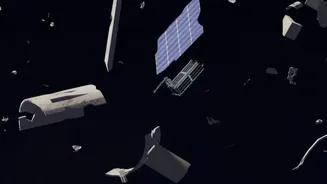
Decades of space activity have left behind a trail of spent rocket stages, defunct satellites, and fragments from past collisions. There are an estimated 130 million pieces of junk, with nearly 30,000 objects large enough to be tracked. Even a tiny fragment, travelling at speeds over 25,000 km/h, can strike an operational satellite with the force of a hand grenade, potentially creating even more debris. Experts fear a cascade effect known as the Kessler Syndrome, where collisions create more debris, leading to more collisions, rendering entire orbits unusable for generations.
The Harpoon: An Ancient Tool for a Modern Problem
To tackle this threat, space agencies and private companies are turning to a surprisingly ancient technology: the harpoon. Missions like the European Space Agency's (ESA) former e.Deorbit concept and the successful RemoveDEBRIS test have explored firing a tethered harpoon into a piece of large, tumbling debris. The chaser satellite would fire the harpoon, which is designed with barbs to securely embed in the target's structure. Once attached, the tether allows the 'hunter' spacecraft to control the target, either pulling it into a lower orbit where it will burn up in the atmosphere or dragging it to a designated graveyard orbit. Companies like Airbus have conducted ground tests, firing prototypes into satellite panels to prove the concept's feasibility and ensure it doesn't create more fragments upon impact.
Casting Nets and Magnetic Tethers
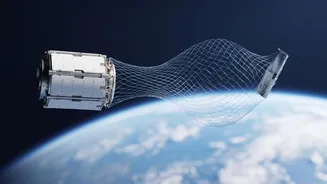
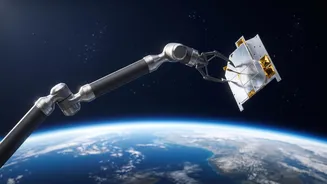
Alongside harpoons, engineers are developing other creative capture methods. One leading alternative is a large net, which would be cast from a chaser satellite to envelop a piece of debris. The RemoveDEBRIS mission, led by the University of Surrey, successfully demonstrated a net capture in orbit. Another promising avenue is magnetic capture. The Japanese company Astroscale, a leader in the field, is developing technology that uses a magnetic docking plate to latch onto specially prepared satellites at the end of their life. This makes capture much simpler and is a key part of their 'end-of-life' services for satellite operators. Other concepts being explored include robotic arms with powerful grippers, gecko-inspired adhesives, and even ion-beam shepherds that would gently push debris without physical contact.
The Emerging Business of Orbital Cleanup
For decades, space debris was a problem everyone acknowledged but no one wanted to pay to fix. That's changing rapidly. The rise of mega-constellations from companies like SpaceX and OneWeb has made LEO increasingly valuable real estate. This has created a genuine business case for Active Debris Removal (ADR). The market for space debris removal and in-orbit servicing is projected to be worth over a billion dollars in 2025 and could grow to nearly $3 billion by the early 2030s. Companies like Astroscale and ClearSpace are pioneering this new industry, securing contracts with space agencies like ESA and JAXA to perform demonstration missions. The model is shifting from one-off experimental missions to providing 'Debris Removal as a Service' (DRaaS), where satellite operators can essentially subscribe to a cleanup service to protect their assets.