


A Planet Covered in Killers
On Mars, dust is not just a nuisance; it is an existential threat. For solar-powered explorers like NASA's rovers and landers, survival depends on converting the faint Martian sunlight into electricity. But the planet is covered in a fine, talc-like dust that
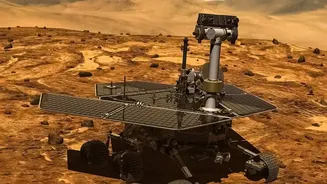
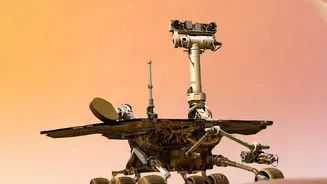
the thin atmosphere easily whips into the air. This dust settles everywhere, forming a power-sapping blanket on solar arrays. Over time, the energy levels drop until the machine can no longer operate. This isn't a theoretical problem. The legendary Opportunity rover, which was planned for a 90-day mission and lasted 15 years, finally met its end in 2018 when a planet-encircling dust storm blotted out the sun. Similarly, the InSight lander, after years of groundbreaking science, fell silent in late 2022 as its panels became hopelessly coated. This makes understanding Martian dust not just an academic exercise, but a critical part of mission operations and a high-stakes business of protecting robotic assets.
The Eyes in the Martian Sky
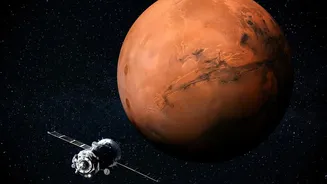
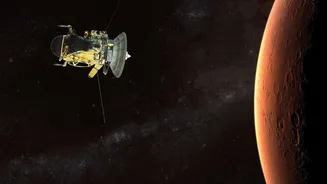
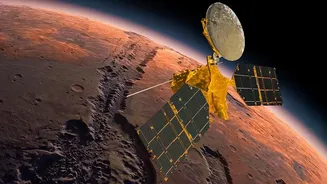
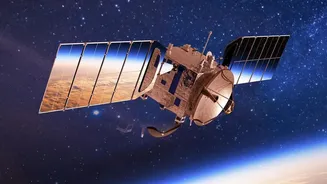
Fortunately, NASA has a fleet of sentinels orbiting Mars, acting as a planetary-scale weather service. The star player in this effort is the Mars Reconnaissance Orbiter (MRO), which has been circling the Red Planet since 2006. MRO is equipped with a suite of powerful instruments, most notably the Mars Color Imager (MARCI) and the High-Resolution Imaging Science Experiment (HiRISE). MARCI acts like a weather satellite, capturing a daily global map of Mars and allowing scientists to watch storms as they form and travel across the planet. HiRISE, meanwhile, is a telescopic camera that can spot features on the surface as small as a dinner table from hundreds of kilometers up. This allows it to see the incredibly detailed aftermath of wind activity, like the delicate, spidery tracks left behind by dust devils. Together, these instruments provide a comprehensive view of Martian dust activity, from global storms to local gusts.
Decoding the Seasonal Pulses
Through years of patient observation, scientists have discovered that Mars's dust storms are not entirely random. They follow predictable seasonal patterns, or "pulses." Mars has a more elliptical orbit than Earth, bringing it significantly closer to the sun during its southern hemisphere's spring and summer. This extra heat energizes the atmosphere, making this period the planet's official "dusty season." Orbiters have identified specific types of large, regional storms that appear sequentially around the same time each Martian year. Rather than just tracking the visible dust clouds, instruments like the Mars Climate Sounder on MRO measure atmospheric temperature. Since dust absorbs sunlight and heats the air around it, temperature spikes are a clear indicator of a brewing storm, giving scientists an early warning system.
From Observation to Operation
This orbital reconnaissance is directly translated into action on the ground. By combining data from MRO and other orbiters, mission planners can create Martian weather forecasts. These forecasts allow them to predict when a rover's location might be at risk from a dust storm. When a significant storm is anticipated, the rover's human operators back on Earth can take preemptive measures. They can command the rover to enter a low-power "safe mode," halting all non-essential science and movement to conserve energy. This is exactly what the InSight team did during a major regional storm in early 2022, buying the lander precious time. This forecasting also helps planners budget for a rover's long-term power. They know to expect lower power generation during the dusty season and can plan science activities accordingly. The data even helps them hope for the opposite of a storm: a "cleaning event," where a strong gust of wind serendipitously clears the panels, a phenomenon that dramatically extended the lives of the Spirit and Opportunity rovers.