



More Than Just a Pretty Picture
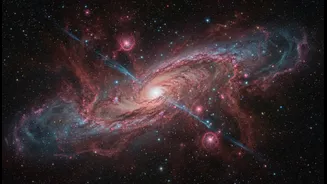
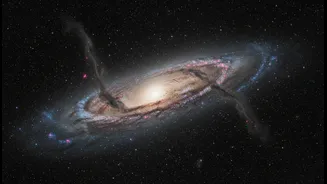
To celebrate its fourth year of science operations, the James Webb Space Telescope (JWST) has released a breathtaking new view of the galaxy Centaurus A. At first glance, the image is a spectacular tapestry of light and shadow, but it's the details that
have astronomers excited. Unlike previous telescopes, Webb's powerful infrared vision can pierce through the thick lanes of dust that have long obscured the galaxy's heart. Where the Hubble telescope saw darkness, Webb reveals a densely packed field of millions of individual stars. What looks like graininess in the image is actually a sea of stars, each one a data point in a story of galactic evolution. Webb’s view allows for what scientists call “galactic archaeology,” letting them reconstruct the galaxy's tumultuous history star by star.
Meet Centaurus A, A Peculiar Neighbor
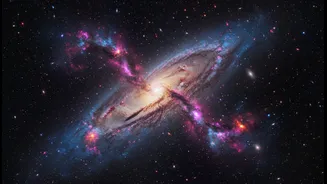
Located about 11 to 13 million light-years away, Centaurus A is a cosmic stone's throw from Earth. Discovered in 1826, it has long been known as an oddball. It looks like a giant elliptical galaxy that has been sliced through by a dark, warped band of dust. This strange structure is the scar of a violent past. Astronomers believe Centaurus A is the result of a merger between a large elliptical galaxy and a smaller spiral galaxy that occurred roughly two billion years ago. This collision is not a singular event, but a long, drawn-out process whose aftermath is still unfolding. The mangled remains of the spiral galaxy provide the raw material for a burst of ongoing star formation, something not typically seen in placid elliptical galaxies.
A Black Hole's Furious Feast
At the heart of all this chaos is a supermassive black hole, about 55 million times the mass of our sun, and it is actively feeding. The galactic merger is funneling gas and dust toward the galaxy's center, where the black hole consumes it. This process is messy and incredibly powerful. As material swirls into the black hole, it releases enormous amounts of energy, launching powerful jets of particles that travel at nearly the speed of light. These jets, which are best seen in radio and X-ray light, stretch for thousands of light-years and have a profound impact on the surrounding galaxy. Centaurus A is the closest active galactic nucleus (AGN) to Earth, making it a perfect natural laboratory for studying how these behemoths shape the galaxies they inhabit.
What Webb Sees That Others Couldn't
Previous telescopes gave us tantalizing hints of what was happening inside Centaurus A. The Hubble Space Telescope captured the visible light from its stars but was blinded by the dust. The retired Spitzer Space Telescope could see in the infrared but lacked the resolution to pick out individual stars or fine details. Webb changes the game. Its combined near- and mid-infrared cameras provide both clarity and depth. This allows astronomers not just to see the stars, but to study the intricate structures of dust and gas. Webb's data reveals glowing, wispy filaments and even a mysterious 'S' shaped feature that defies easy explanation. By studying how gas moves—some rotating near the black hole, some being pushed away—scientists get a front-row seat to the cosmic balancing act where black holes can both trigger and suppress the birth of new stars.