





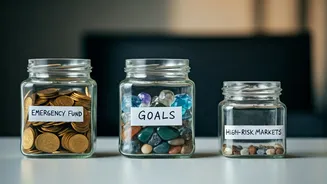



The Trader’s Biggest Mistake
For active traders and investors, the single greatest unforced error is co-mingling funds. This means treating your emergency savings, short-term goal money, and trading capital as one big pot. When the market is climbing, it seems logical. Why let cash
sit idle in a savings account when it could be compounding in a winning stock? This line of thinking, however, ignores the primary purpose of an emergency fund: it's not an investment; it's insurance. It’s the financial firewall that stands between a market downturn and a personal financial crisis. When you mix them, a bad trading streak can wipe out not just your risk capital, but also the money you need to fix a broken-down car or cover an unexpected medical bill.
Your Brain Is Working Against You
The need for separation isn't just about practical accounting; it's about managing your own psychology. Human beings are notoriously irrational with money, and the high-stakes environment of trading amplifies these biases. After a series of profitable trades, overconfidence can set in. You start to feel invincible, and that ‘idle’ emergency cash looks like perfect fuel to chase even bigger returns. Conversely, during a losing streak, panic can lead to 'revenge trading' — making bigger, riskier bets to win back what you’ve lost. An easily accessible, co-mingled fund makes it dangerously easy to act on these destructive impulses. By creating a separate, less accessible emergency pool, you erect a behavioural barrier that protects you from your worst emotional decisions.
How to Define Your Emergency Pool
An emergency fund isn't a vague concept; it should be a calculated number. The standard advice is to have three to six months' worth of essential living expenses saved. However, for traders and freelancers with variable income, this should be considered the absolute minimum. A more prudent target is nine to twelve months of expenses. To calculate this, list all your non-negotiable monthly costs: rent or EMI, utilities, groceries, insurance premiums, and basic transport. Multiply that total by your chosen number of months (say, 9). This is your target number. This is not money for a vacation or a down payment. This is the 'break glass in case of emergency' fund that allows you to survive a job loss, a medical crisis, or a prolonged bear market without being forced to liquidate your trading portfolio at the worst possible time.
Where to Keep This Sacred Cash
The goal for your emergency fund is safety and liquidity, not high returns. Chasing yield with this money defeats its entire purpose. You need to be able to access it quickly without worrying about market fluctuations. Excellent options in the Indian context include: 1. **High-Yield Savings Account:** Keep it in a bank completely separate from the one linked to your trading account. This small amount of friction prevents casual transfers. 2. **Fixed Deposits (FDs):** A ladder of FDs (e.g., creating a new one each month for several months) can provide slightly better returns than a savings account while keeping the money locked away for short periods. You can break them in an emergency, albeit with a small penalty. 3. **Liquid Mutual Funds:** These funds invest in very short-term debt instruments and are considered relatively low-risk with high liquidity, typically allowing you to redeem money within a day. They offer a modest return, often better than a savings account.
Building the Unbreachable Wall
Setting up the system is simple. First, open a new bank account at a different bank for your emergency fund. Calculate your target and set up a systematic, automatic transfer from your primary income account every month. Treat this transfer like any other bill — it's non-negotiable. Don’t stop until you hit your target. More importantly, create a strict, written definition of 'emergency'. A market dip is not an emergency. A hot stock tip is not an emergency. A sudden, unexpected, and essential expense that you cannot otherwise cover is an emergency. This discipline is the cornerstone of protecting your earnings. Your trading account is for building wealth; your emergency fund is for preserving your life.