





An Earth, But Not As We Know It
The target for this ambitious mission is Titan, Saturn's largest moon. Titan is an explorer's dream, a world that is both strangely familiar and profoundly alien. It is the only moon in our solar system with a thick, nitrogen-rich atmosphere, even denser
than Earth's. This atmosphere supports a weather system, but instead of water, Titan has methane. Methane forms clouds, falls as rain, and carves rivers and lakes into the moon's surface. Beneath a crust of water ice, scientists believe there is a vast liquid water ocean. This unique combination of complex organic molecules, energy, and the potential for liquid water makes Titan a prime target for astrobiology—the search for the ingredients of life.
Why Fly When You Can Drive?
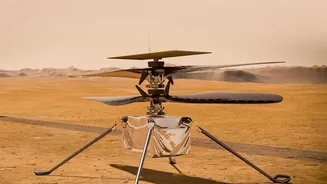
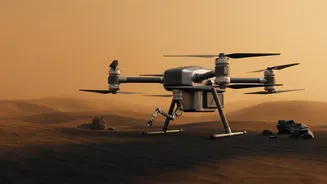
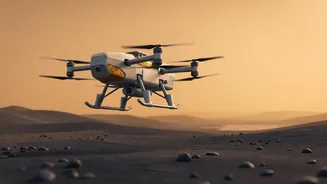
For decades, our image of exploring other worlds has been defined by rovers. Dragonfly shatters that mold. It's an octocopter—a drone with eight rotors—designed to fly through Titan's skies. This is only possible because of Titan’s unique environment. Its atmosphere is four times denser than Earth's, and its gravity is only about one-seventh as strong. This combination makes flight incredibly efficient; a vehicle can get airborne with far less power than on Earth or Mars. Instead of being limited to a single landing area, Dragonfly will be able to fly from site to site, covering dozens of miles in a single hop. This allows it to act as a relocatable laboratory, sampling diverse geological settings from icy craters to vast organic sand dunes that are visually similar to those in Earth's Namib Desert.
Powered by Nuclear Heart
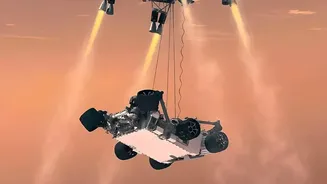
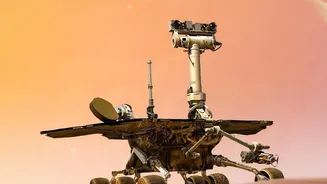
Dragonfly can't use solar panels. Titan is so far from the Sun, and its hazy atmosphere blocks so much light, that solar power is not a viable option. Instead, the rotorcraft will be powered by a Multi-Mission Radioisotope Thermoelectric Generator, or MMRTG. This is the same type of nuclear power source used on the Curiosity and Perseverance Mars rovers, which converts heat from the natural decay of plutonium into electricity. This reliable power source will keep Dragonfly's systems warm in the extreme cold (around -179°C) and recharge its batteries. A single flight will be powered by its batteries, and then the craft will spend one Titan night (about eight Earth days) on the ground, recharging via the MMRTG before it's ready for its next journey.
A Prebiotic Chemistry Lab on the Move
The core purpose of Dragonfly isn't to find existing life but to investigate 'prebiotic chemistry'. This means studying the complex organic molecules that are the building blocks of life as we know it, which are abundant on Titan's surface. Scientists believe the conditions on Titan might be similar to those on early Earth, before biology began. Dragonfly is equipped with a suite of instruments to analyze this chemistry. It carries drills on its landing skids to collect samples of ice and organic materials. These samples are then fed into an onboard mass spectrometer, which will analyze their composition in detail. By visiting multiple sites, including an impact crater where liquid water may have once mixed with these organics, Dragonfly could help answer fundamental questions about how life arises.
A Leap in Autonomous Exploration
Operating a drone from over a billion kilometers away presents an enormous challenge. The one-way light time to Titan is more than an hour, making real-time control impossible. This means Dragonfly must be highly autonomous. For each flight, engineers on Earth will provide target coordinates, but the craft itself will be responsible for navigating, identifying safe landing zones, and avoiding hazards in real-time using its own sensors and systems. This represents a significant step forward from the more supervised driving of Mars rovers. It combines the mobility of a helicopter with the analytical power of a full-scale rover laboratory, a capability NASA has never before deployed on another world.