



A Landmark Investment
Eka Robotics, a startup founded by an MIT professor and a former Google DeepMind researcher, recently announced it has closed a $150 million Series A funding round. The investment was co-led by prominent venture capital firms Andreessen Horowitz (a16z)
and F-Prime, with participation from several other investors. This substantial financial injection values the young company at an impressive $1.45 billion and underscores the immense investor confidence in its pioneering technology. The funds are earmarked to scale the company's technology, expand its AI model to handle more complex tasks, and accelerate customer deployments, moving its advanced robots from the lab to real-world industrial settings.
The Challenge of Robotic Touch
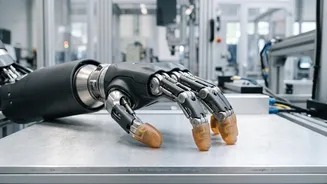
For decades, industrial robots have excelled at repetitive, highly structured tasks, like welding car parts on an assembly line where every piece is in a predictable position. However, they have struggled with tasks requiring finesse and adaptability. The ability to pick up a variety of objects—a soft strawberry, a slippery component, or a delicate wire—has remained largely in the human domain. This is because traditional robots rely almost exclusively on vision. They can see where an object is, but they can't 'feel' it. This lack of tactile feedback is what Eka Robotics calls the 'last millimeter problem', the critical moment of contact where a task can fail if the grip is too hard, too soft, or misaligned.
Eka's Vision-Force-Action Model
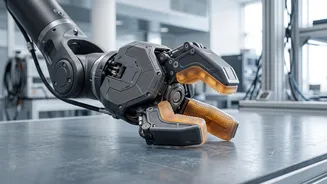
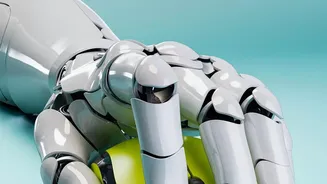
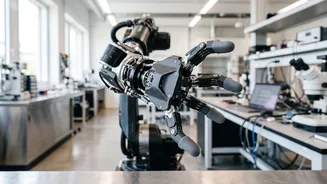
Eka's breakthrough is a new AI architecture it calls the Vision-Force-Action (VFA) model. Instead of just relying on cameras, Eka's robots are equipped with advanced, force-sensitive grippers that provide a rich stream of tactile data. The VFA model processes this touch information alongside visual data, allowing the robot to develop an 'intuition' for physics. It can feel if an object is slipping and adjust its grip, or sense the precise force needed to screw in a lightbulb without breaking it. This approach moves beyond simply mimicking human actions. Eka trains its robots using reinforcement learning in a simulated environment, allowing them to generate and learn from thousands of hours of experience in minutes, mastering physics in a way that human demonstration can't replicate.
Superhuman Performance in Practice
The results of this novel approach are already demonstrating capabilities that surpass human workers in specific scenarios. Eka reports its robots can reliably pick and place unfamiliar objects at a rate of approximately 1,500 items per hour, with over 95% accuracy. This is more than double the average human performance of around 600 items per hour. These robots are not just fast; they are also versatile, capable of handling tasks from sorting items in a warehouse bin to performing delicate wire insertions. This level of performance and generality is what makes the technology so disruptive, offering a solution that is both highly efficient and broadly applicable.
Transforming Indian and Global Industries
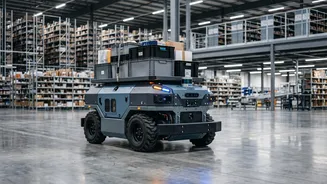
The implications of dexterous robotics are vast, poised to transform industries central to the Indian and global economies. In logistics and e-commerce, these robots can automate warehouse tasks, speeding up order fulfillment and addressing labour shortages. In manufacturing, they can take on complex assembly jobs that were previously impossible to automate, enhancing precision and efficiency. The technology also holds promise for sectors like healthcare, where dexterous robots could assist in procedures requiring a delicate touch, and agriculture, handling produce without causing damage. As India continues to push initiatives like 'Make in India' and establish itself as a technology hub, innovations from startups like xSpecies AI in Bengaluru and the broader focus on physical AI at research parks are creating a vibrant ecosystem for next-generation robotics.