


Shivnarine Chanderpaul: The Crab-like Genius
Arguably the king of unorthodoxy, Shivnarine Chanderpaul’s stance was one of cricket’s great curiosities. The West Indian legend would plant his feet pointing down the pitch, his chest facing the bowler in a strange, open, crab-like setup. To the uninitiated,
it looked completely wrong, a posture that should make batting impossible. Yet, from this awkward-looking base, Chanderpaul would shuffle into a more conventional position just as the ball was released, allowing him to see the delivery with both eyes for longer. The method was born out of necessity, a way to protect himself from hostile fast bowling as a young player. It clearly worked. Over a stellar career, he amassed over 11,000 Test runs at a remarkable average of over 51, proving that effectiveness trumps aesthetics every time.
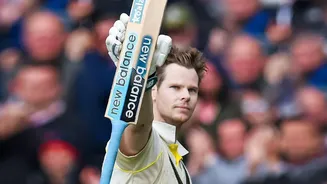
Steve Smith: The Fidgety Master
Watching Steve Smith bat is to witness controlled chaos. He fidgets, shuffles dramatically across his crease, and employs an exaggerated backlift that points towards the slip fielders. His technique is a collection of movements that would have any traditional coach tearing their hair out. But every single quirk has a purpose. His large trigger movement across the stumps is designed to get him outside the line of off-stump, minimising the risk of being dismissed LBW. His incredible hand-eye coordination then takes over, allowing him to whip balls from well outside off-stump through the leg side. While his style may not be as classically beautiful as some of his peers, his results are undeniable. With one of the highest Test batting averages in the modern era, Smith has proven that his unique system makes him one of the most difficult batters to bowl to in history.
Fawad Alam: The Cross-Stance Conundrum
If Chanderpaul’s stance was open, Fawad Alam’s is on another planet. The Pakistani left-hander sets up almost square-on to the bowler, his shoulders and chest pointing towards cover, with his bat held high in the air. As the bowler runs in, he executes a pronounced shuffle that brings him back into a hitting position. It’s a technique so peculiar that it has been a constant topic of discussion throughout his career. Critics have often questioned its viability at the highest level, yet Alam has been a prolific run-scorer in domestic cricket and made a successful return to the Test arena after a decade-long absence. He has said that he adopted the stance after a recommendation from Chanderpaul himself, and it gives him a different way to judge the line and length of the ball.
George Bailey: The Back-to-the-Bowler Stance
Perhaps the most bewildering stance on this list belongs to former Australian captain George Bailey. In the latter part of his career, Bailey adopted a pre-delivery setup where he would turn his body so much that his back was almost facing the bowler. From this utterly closed-off position, he would swivel back into a more orthodox alignment as the ball was delivered. The sight of a batter showing his shirt number to the bowler was so unusual it often left commentators and opposing players laughing in disbelief. Bailey explained that the bizarre movement was designed to ensure his back foot remained side-on, which he felt gave him a more stable base to hit from. It was a radical solution to a technical issue, but it worked for him, highlighting a player more concerned with results than how he looked.
Kevin Pietersen: The Fearless Innovator
While the others on this list are known for their stances, Kevin Pietersen’s unorthodoxy came from his shot selection. The swashbuckling England batter was a pioneer of inventive, aggressive strokes, none more famous than the "switch hit." By changing his grip and stance from a right-hander to a left-hander in the fraction of a second before the ball arrived, Pietersen could hit a ball to the completely opposite side of the field. First used to great effect against the legendary Muttiah Muralitharan, the shot was so revolutionary that there were initial calls for it to be banned. Pietersen argued it was just innovation, a new way to score runs and put pressure on the bowler. Along with his famous "flamingo" flick through the leg side, Pietersen’s creative and audacious shot-making redefined what was possible for a modern batter.