


A Sweet Discovery in the Void
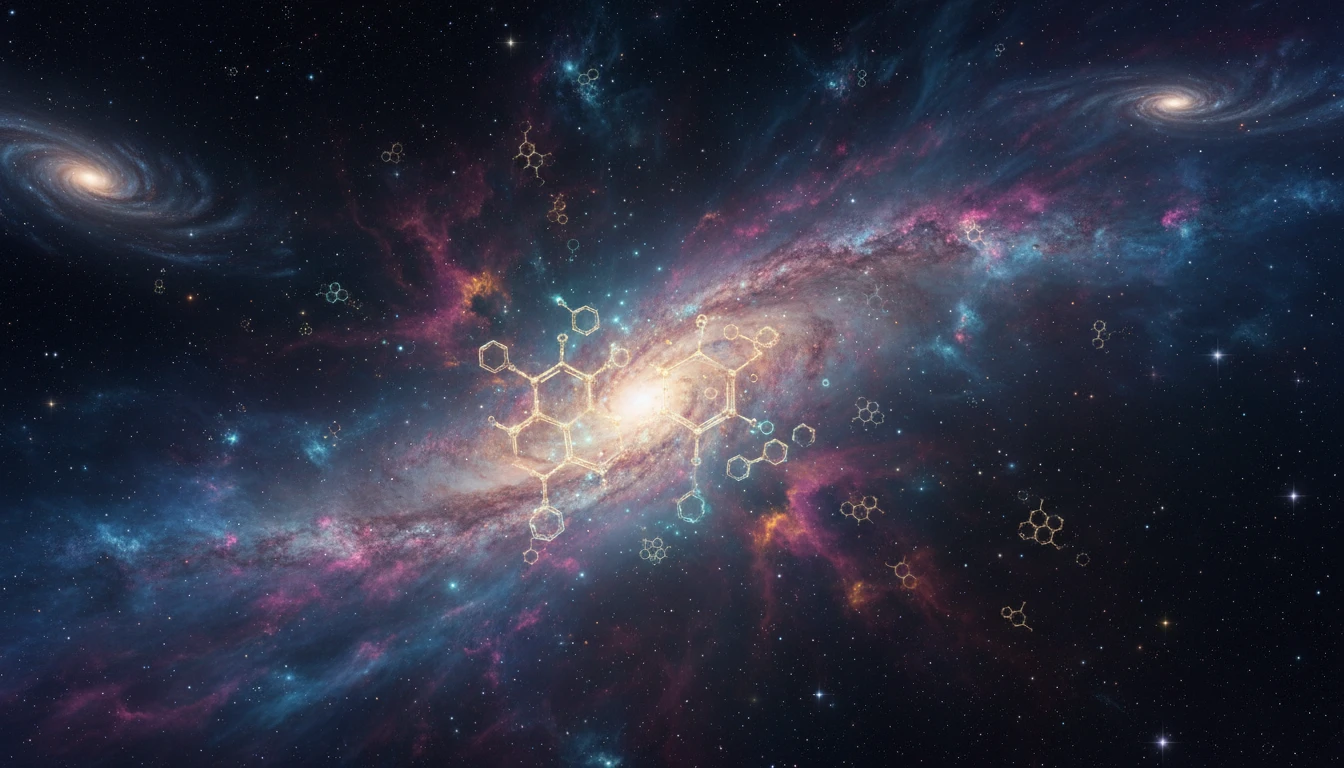
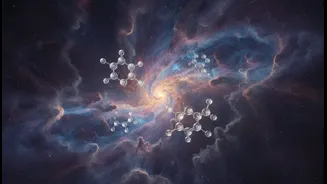
In a breakthrough for astrobiology, an international team of scientists has identified a sugar molecule called erythrulose floating in a molecular cloud near the heart of the Milky Way. The discovery was made using powerful radio telescopes in Spain that
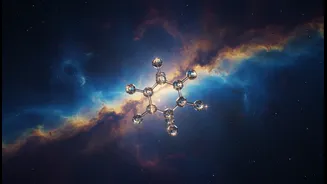
can detect the unique radio signals, or spectral lines, emitted by specific molecules across the vastness of space. This marks the first time a sugar of this type has been found in the interstellar medium—the seemingly empty space between stars. On Earth, erythrulose is a four-carbon sugar found in fruits like raspberries. Its presence in a distant gas cloud named G+0.693−0.027, some 27,000 light-years away, is profound because it confirms that complex organic molecules, crucial for life, can form in the harsh conditions of deep space, long before planets even exist.
The Building Blocks of Biology
While you won't be sweetening your tea with cosmic sugar, its discovery is incredibly significant. Sugars are fundamental to biology. They form the structural backbone of RNA (ribonucleic acid) and DNA (deoxyribonucleic acid), the molecules that carry the genetic instructions for all known life. The origin of these first sugars on Earth has long puzzled scientists, as prebiotic conditions on our young planet may not have been sufficient to produce them in large quantities. Erythrulose is particularly interesting because it is a potential precursor for producing ribonucleotides, the building blocks of RNA. Its existence in space suggests that the essential ingredients for life didn’t necessarily have to form on Earth first. They could have been delivered from the cosmos.
A Boost for the 'RNA World' Hypothesis
This discovery lends strong support to a leading theory on the origin of life known as the 'RNA World' hypothesis. This theory suggests that before DNA and proteins dominated biology, life was based on simpler RNA molecules that could both store genetic information and act as catalysts for chemical reactions. For an RNA World to emerge, a ready supply of its building blocks, including sugars like ribose, would have been necessary. Finding a sugar like erythrulose—a potential stepping stone to ribose—in a star-forming region suggests that these vital components were widely available in the early solar system. The detection of erythrulose proves that the universe's chemical factories are capable of creating these complex structures, making the RNA World a more plausible scenario for life's dawn.
Delivered by Comets and Asteroids?
How could sugar from a distant gas cloud end up on Earth? The answer likely lies in the theory of panspermia, which proposes that life's ingredients, or even microbial life itself, can be distributed throughout the universe by meteoroids, asteroids, and comets. Scientists have previously found other key organic molecules, like amino acids and the nucleobases of DNA and RNA, in meteorites that have landed on Earth. Researchers estimate that during the Late Heavy Bombardment period around 4 billion years ago, as many as 50 million tonnes of erythrulose could have rained down on the young Earth. This cosmic delivery service could have supplied our planet with a rich inventory of prebiotic molecules, creating a primordial soup ripe for the emergence of the first life forms.
What Comes Next in the Search?
The discovery of erythrulose is not the end of the story, but rather an exciting new chapter. Scientists were surprised to find this four-carbon sugar in such abundance, as it challenges previous theories that complex molecules form by adding one carbon atom at a time. The team believes erythrulose may form from the combination of simpler two-carbon molecules. This finding opens up new avenues for research into interstellar chemistry. The next goal for astrochemists is to search for even more complex sugars, particularly ribose, the five-carbon sugar that forms the very backbone of RNA. With advanced instruments like the James Webb Space Telescope, scientists are better equipped than ever to scan the cosmos for these faint molecular signals, bringing us ever closer to understanding our own cosmic origins.