


How does a planet, once celebrated as a landmark discovery, simply vanish? Astronomers have finally solved the curious case of Fomalhaut b, a world that appeared to disappear, revealing a far more violent and chaotic story than anyone expected.
The Ghost Planet
In 2008,
the world of astronomy was buzzing. Scientists using the Hubble Space Telescope announced the first-ever direct visual image of an exoplanet, a planet outside our solar system. Located 25 light-years away, the object, named Fomalhaut b, was a point of light orbiting the bright star Fomalhaut. For years, it was celebrated as a milestone. Unlike other exoplanets that were detected indirectly through the dimming of their star or the gravitational wobble they induced, this one was seemingly caught on camera. However, Fomalhaut b was always a bit of an oddball. It was surprisingly bright in visible light, yet had no detectable heat signature in the infrared, which is highly unusual for a large planet. This cosmic puzzle left scientists scratching their heads.
A Cosmic Disappearing Act
The mystery deepened over the next few years. As astronomers continued to track Fomalhaut b using Hubble, they noticed it was doing things a planet should not do. For one, it seemed to be fading. Then, when analysing images taken in 2014, they were met with a stunning realisation: Fomalhaut b was gone. It had completely vanished from sight. Planets don't just disappear. This development was the final nail in the coffin for the theory that Fomalhaut b was a conventional planet. The object that had once been hailed as a breakthrough discovery had become a phantom, prompting a new investigation into what it could have been. The clues pointed not to a stable, orbiting world, but to the aftermath of a violent, transient event.
The Collision Theory
A team of astronomers, led by András Gáspár and George Rieke from the University of Arizona, pieced together the evidence from over a decade of Hubble observations. Their conclusion was dramatic: Fomalhaut b was never a planet at all. Instead, what Hubble had first observed in 2004 was an expanding cloud of incredibly fine dust. They proposed that this dust cloud was the result of a colossal collision between two large icy bodies, each estimated to be about 200 kilometers across. These planetesimals, large objects on their way to becoming planets, would have smashed into each other shortly before the first observation. The event was a rare and spectacular cosmic crash, a blueprint for how planets can destroy each other.
Evidence in the Dust
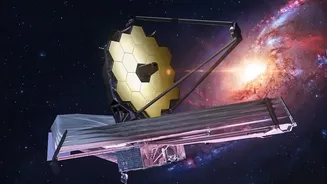
This new model elegantly explained all of Fomalhaut b's strange behaviours. The initial brightness was the sunlight reflecting off a dense, fresh cloud of dust and ice particles. The gradual fading was the cloud itself dispersing into space, expanding and becoming less dense over time. Its disappearance in 2014 simply meant the cloud had spread out so much that it was no longer detectable by Hubble. Further observations, including with the James Webb Space Telescope in 2023, confirmed the absence of any large planetary body and supported the collision theory. What astronomers had witnessed, by being in the right place at the right time, was not the life of a planet, but the immediate, messy aftermath of its potential building blocks being obliterated in an event that happens in the Fomalhaut system only once every 200,000 years.