




An Ocean World in the Outer Solar System
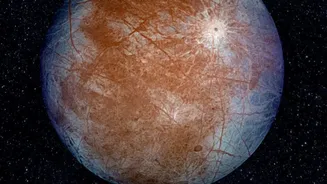
For decades, scientists have been captivated by Europa, one of Jupiter's largest moons. Strong evidence suggests that beneath its frozen crust, which is estimated to be 15 to 25 kilometers thick, lies a vast, liquid saltwater ocean. Astonishingly, this
subterranean sea may hold more than twice the amount of water found in all of Earth's oceans combined. Where there is liquid water, there is the potential for life, making Europa one of the most compelling destinations in our solar system to search for habitable environments beyond Earth. The Europa Clipper mission was designed specifically to investigate this possibility by getting a closer look than ever before.
Not Looking for Aliens, But for Ingredients
It is important to clarify that Europa Clipper is not a life-detection mission; it won't be looking for alien organisms swimming in the dark. Instead, its primary goal is to determine if Europa has the necessary conditions to support life as we know it: liquid water, essential chemical elements, and sources of energy. The mission's nine advanced science instruments will work together to understand the moon's ice shell, the composition of its ocean, and its geology. Think of it as a reconnaissance mission to assess the moon's habitability, paving the way for potential future missions that could one day search for life itself.
A Toolkit for an Icy World
To peer beneath the ice and taste the environment, Europa Clipper is equipped with a powerful suite of instruments. An ice-penetrating radar, called REASON, is designed to measure the thickness of the ice shell and search for pockets of water within it, or even confirm the ocean's presence directly. Spectrometers will analyze the chemical makeup of the surface, looking for salts and organic compounds that might give clues about the ocean's composition. High-resolution cameras will map nearly 90% of Europa's surface in stunning detail, far surpassing previous images and helping to identify geologically active areas like potential cryovolcanoes. A thermal imager will hunt for 'hot spots' where warmer water from below might be close to the surface.
The Long Journey to Jupiter
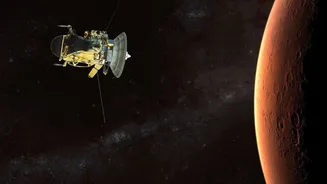
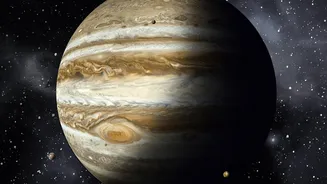
Launched in October 2024, the Europa Clipper is undertaking a long and strategic voyage. By September 2026, the spacecraft is well into its cruise phase. It has already completed a gravity-assist flyby of Mars in early 2025 and is now on a trajectory back towards our own planet. In December 2026, it will perform a crucial Earth flyby, using our planet's gravity to slingshot itself on a high-speed path toward the outer solar system. The spacecraft is scheduled to arrive at Jupiter in April 2030. Once there, it won't orbit Europa directly due to the intense radiation from Jupiter. Instead, it will enter a long, looping orbit around the gas giant, performing nearly 50 close flybys of Europa over several years, each time gathering precious data from a different part of the moon.