





First of All, They're Not Worms
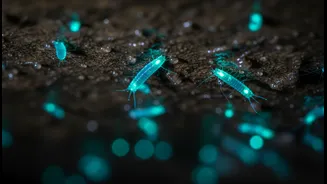
Let's clear up the biggest misconception first: the most famous glowing worms aren't worms at all. The dazzling displays in the caves of New Zealand and Australia are created by the larvae of a tiny insect called a fungus gnat. The specific species, Arachnocampa
luminosa, has a name that roughly translates to 'glowing spider-bug', a nod to the silky, web-like snares it uses to hunt. The term 'glowworm' is also used for the larvae or wingless adult females of various beetle species, including fireflies. So, when you see a reference to a glowworm, you are almost always looking at the juvenile stage of a fly or a beetle, which spends the majority of its life in this larval form.
The Science of a Natural Lantern
The ethereal glow is a biological process called bioluminescence, a chemical reaction that produces 'cold light' with remarkable efficiency. Inside a specialised organ, a light-emitting molecule called luciferin reacts with oxygen. This reaction is controlled by an enzyme called luciferase, and the whole process is powered by ATP, the same energy-carrying molecule found in all living cells. The result is a steady blue-green light that wastes almost no energy as heat. Interestingly, this ability to produce light is thought to have evolved independently more than 30 times across different species, a testament to its evolutionary advantage. The specific chemical recipe varies, meaning the glow of a New Zealand fungus gnat and that of a European beetle evolved separately to solve similar problems.
A Deadly and Dazzling Trap
While beautiful to us, a glowworm's light serves a deadly purpose: to attract prey. The fungus gnat larva builds a nest of silk and mucus on a damp, dark ceiling and then dangles dozens of sticky 'fishing lines'. Small flying insects, like midges and mayflies, are drawn towards the light, mistaking it for moonlight shining through an exit. Instead of freedom, they become ensnared in the sticky droplets. The larva feels the vibrations and reels in its meal. A brighter glow often means a hungrier larva, intensifying its light to improve its chances of a catch. For other types of glowworms, like the wingless female firefly, the glow serves a different purpose: attracting a winged male mate in the darkness.
A Global Glow, With Local Wonders
While New Zealand’s caves are famous, bioluminescence is a worldwide phenomenon. In India, this natural light show takes on different forms. Several beaches along the coasts of Maharashtra, Karnataka, Goa, and the Andaman and Lakshadweep islands come alive at night with the blue glow of marine plankton. When disturbed by waves or movement in the water, these tiny organisms emit flashes of light, turning the shoreline into a starlit sea. Inland, particularly in the forests of the Western Ghats and Meghalaya, a different kind of glow appears during the monsoon. Here, bioluminescent mushrooms of the Mycena species cast an eerie greenish light from the forest floor, a phenomenon locals have known about for generations but has only recently been documented by scientists.
Why They Are More Than Just a Spectacle
These glowing creatures are more than just a tourist attraction; they are vital indicators of a healthy ecosystem. Glowworms thrive in very specific conditions: dark, damp, and undisturbed environments with clean water sources to support their insect prey. Their presence signals that a habitat is thriving. However, they are incredibly vulnerable. Light pollution from human development can confuse both predator and prey, disrupting hunting and mating cycles. Pesticides can poison their food sources, and habitat loss destroys the delicate environments they need to survive. Protecting these luminous beings means protecting the entire ecosystem they are a part of, from the purity of the water to the darkness of the night sky.