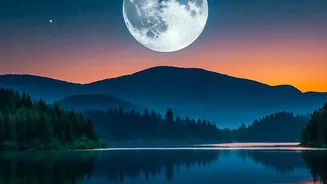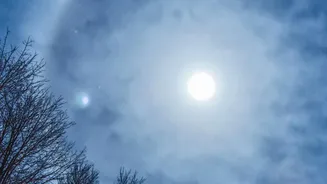






Have you ever looked up at the night sky and seen a perfect, glowing circle around the moon? It’s a breathtaking sight, often mistaken for a celestial mystery or a trick of the eye. But this beautiful ring is a well-understood natural event.
An Optical Illusion in the Atmosphere
That luminous
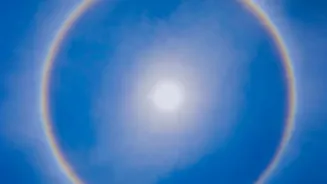
circle is not actually around the moon itself. It's an optical phenomenon happening much closer to home, high in Earth's atmosphere. Scientists call it a 22-degree halo, named for the specific radius of the ring. This halo forms when moonlight passes through a thin veil of high-altitude clouds, typically cirrus or cirrostratus clouds, that are often invisible to the naked eye. These clouds, drifting more than 6 kilometres above the ground, are so high up that the water vapour within them freezes into millions of tiny ice crystals.
The Science of Ice and Light
The magic of the halo lies in the shape of these ice crystals. They form as microscopic hexagonal columns, like tiny six-sided pencils. As moonlight shines through them, the crystals act like miniature prisms. The light ray enters one face of the hexagon and is bent, or refracted. It is bent again when it exits through another face. Due to the precise geometry of these crystals, the light is consistently deviated by about 22 degrees from its original path. Your eye only catches the light that has been bent at this exact angle, which combines from millions of different crystals to form the distinct, glowing ring you see.
Halo or Corona?
Not every ring around the moon is a 22-degree halo. Sometimes, a smaller, more colourful, and fuzzier ring called a corona can appear. It's important to know the difference. A halo is large, with a radius of 22 degrees (about the width of your outstretched hand held at arm's length), and is caused by the refraction of light through ice crystals. A corona, on the other hand, is much smaller and sits tighter to the moon. It's formed by the diffraction of light through liquid water droplets in mid-level clouds, not ice. If you see faint rainbow-like colours in a halo, red will be on the inside edge, while in a corona, the colour pattern is typically blue on the inside and red on the outside.
An Old Weather Proverb
There's a well-known piece of folklore: 'A ring around the moon means rain or snow is coming soon'. This old saying often holds true. The high-level cirrus clouds that create lunar halos are frequently the first sign of an approaching weather system. These wispy clouds often move in a day or two ahead of a storm front, which brings moisture and precipitation. So, while the halo itself doesn't cause bad weather, it serves as a beautiful advance warning that the atmospheric conditions are changing. It’s a genuine piece of weather forecasting wisdom passed down through generations.
A Personal Celestial Show
One of the most fascinating aspects of a lunar halo is that it's a personal experience. Like a rainbow, the halo you see is unique to you. The ring is formed by light being refracted by specific ice crystals that are perfectly positioned relative to your eyes. A person standing just a few metres away is seeing a completely different halo formed by a different set of ice crystals. This celestial display, best seen when the moon is bright and near full, is a personal alignment of moonlight, ice, and your own point of view in the vastness of the night sky.