


Meet the 'Warm Neptunes'
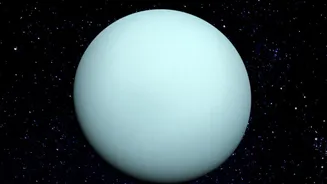
Across the galaxy, one of the most common types of planets we've discovered is the 'sub-Neptune' or 'warm Neptune'. These are worlds larger than Earth but smaller than our own gas giants, Jupiter and Neptune. Unlike our solar system's icy giants, which
orbit far from the Sun's heat, these planets are found much closer to their parent stars. This proximity makes them warm, but also creates a major scientific puzzle. One such world, GJ 1214 b, has been a particular focus for astronomers. It orbits its star so closely that its year lasts only 1.6 Earth days, resulting in searing temperatures that can range from over 270°C on its dayside to 165°C on its night side. These planets are unlike anything in our solar system, making them fascinating laboratories for understanding how planets form and evolve.
The Methane Mystery
According to standard chemical models, the atmospheres of these warm planets should not contain much methane. The intense heat and radiation from the nearby star were expected to quickly break down methane molecules. For years, observations seemed to confirm this, with telescopes finding atmospheres depleted of the gas, creating a disconnect between theory and reality. However, recent, more powerful observations have started to detect the undeniable signature of methane, leaving scientists to wonder: if the methane is being destroyed, where is the new supply coming from? This question pointed to a gap in our knowledge about the atmospheric dynamics of these strange worlds.
A New Look with a Powerful Eye
Enter the James Webb Space Telescope (JWST). Its ability to see in infrared light allows it to pierce through the thick haze and clouds that have long obscured the atmospheres of planets like GJ 1214 b. For one recent study on a different warm Neptune, WASP-107 b, JWST didn't just find methane; it found that the methane was severely depleted compared to what equilibrium chemistry would predict, by a factor of 1,000. This confirmed that some active process was at play. Using its advanced instruments, JWST can create a 'heat map' of a planet as it orbits its star, tracking temperature changes between the day and night sides. This detailed data provides crucial clues about the molecules present in the atmosphere, such as water vapor and methane.
An Atmosphere Making Its Own Gas
The latest data strongly suggests that the methane on these warm Neptunes is not a leftover from the planet's formation but is being actively generated within the atmosphere itself. This process is known as 'photochemistry'. In the upper layers of the atmosphere, intense light from the star acts as a catalyst, breaking apart other carbon-bearing molecules. The resulting atoms and smaller molecules then recombine in new ways, forming methane. At the same time, vigorous vertical winds dredge up gases from the hotter interior, a process called 'transport-induced quenching', which also contributes to this complex chemical factory. Essentially, the atmosphere is a dynamic system constantly destroying and creating methane in a disequilibrium state. On WASP-107b, models show that this vigorous mixing is the dominant process, while photochemistry plays a role in creating other compounds like sulfur dioxide.
Rewriting the Planetary Playbook
This discovery does more than just solve the methane mystery; it fundamentally changes our understanding of exoplanet atmospheres. It shows they are not static, stable layers of gas but are dynamic and complex chemical reactors. The detection of methane and its byproducts also provides insights into a planet's history and internal structure. For example, the specific chemical balance on WASP-107 b allowed scientists to calculate that its core is much more massive than previously thought, resolving a tension with models of how planets form. It also suggests that the atmosphere is rich in elements heavier than hydrogen and helium, indicating it is not a primordial atmosphere but one that has evolved over time. By studying these processes, we can begin to build a more complete picture of the vast diversity of worlds that exist beyond our own.