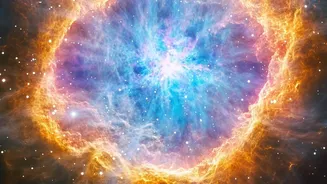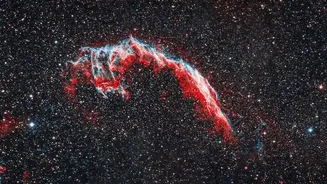




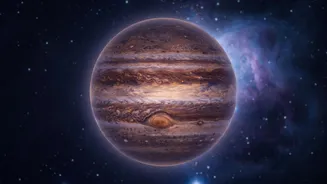

Scattered throughout the cosmos are 'failed stars'—objects that form like stars but never ignite. Now, NASA’s SPHEREx mission is giving us our best look yet at these mysterious worlds, revealing a key factor that shapes their very nature: temperature.
Meet the 'Failed Stars'
In the vast cosmic theater, not every star gets to shine. Some celestial bodies, known as brown dwarfs, are born from the same collapsing clouds of gas and dust as their stellar siblings but never accumulate enough mass to kick-start nuclear fusion in their cores. This is the process that allows stars like our sun to burn brightly for billions of years. Without it, these objects are often called 'failed stars'. With masses somewhere between 13 and 80 times that of Jupiter, they are too large to be considered planets but too small to be stars. They form in isolation, heat up from the gravitational energy of their formation, and then slowly cool and fade into the darkness of interstellar space over millions of years, making them fascinating subjects for understanding the dividing line between planets and stars.
SPHEREx: A New Eye on the Sky
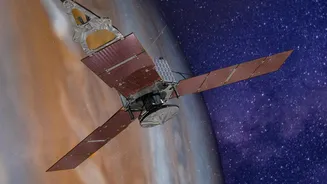
Enter NASA's SPHEREx mission, an orbiting observatory with a unique capability. Short for Spectro-Photometer for the History of the Universe, Epoch of Reionization, and Ices Explorer, this space telescope is mapping the entire sky in 102 different colors of infrared light. While other powerful telescopes like the James Webb Space Telescope can study individual objects in great detail, SPHEREx's all-sky survey allows it to create a massive catalogue of celestial objects, including hundreds of millions of galaxies and thousands of brown dwarfs. By breaking down the infrared light into a spectrum for each object, scientists can identify the chemical composition of their atmospheres, including molecules like water, methane, and carbon dioxide. This comprehensive view is providing an unprecedented dataset on these dim and distant worlds.
The Temperature Revelation
The latest findings from the SPHEREx survey focus on a crucial environmental factor: temperature. By analyzing a group of 37 nearby brown dwarfs spanning a wide temperature range—from a scorching 2,200 degrees Celsius down to a frigid minus 20 degrees Celsius—scientists have observed how their atmospheric chemistry changes. A key transition appears to happen around 870 degrees Celsius. Above this temperature, the atmospheres of brown dwarfs are dominated by thick clouds of silicates and iron. As they cool below this point, these clouds sink deeper into the atmosphere or dissipate, leading to clearer skies where molecules like methane become prominent. This confirms long-held theories that temperature plays a critical role in the atmospheric dynamics and appearance of these objects, essentially dictating whether they are cloudy or clear.
Why These Goth Worlds Matter
Studying these independent, 'goth' worlds, as one scientist described them, offers more than just a glimpse into cosmic curiosities. Because they exist in isolation, without the overwhelming glare of a parent star, their atmospheres are much easier to study than those of exoplanets. This makes brown dwarfs excellent natural laboratories for understanding the atmospheric physics of gas giants. The processes that form clouds of iron and silicate dust on a hot brown dwarf are analogous to weather patterns on giant exoplanets. By observing how these atmospheres evolve across different temperatures, astronomers can refine their models for how planets like Jupiter formed and how their atmospheres behave. The data from SPHEREx is already showing that current models are incomplete, pushing scientists to develop a more nuanced understanding of these complex worlds.