



Messengers from a Distant Sun
For nearly all of history, every object we have studied in our sky has belonged to our own solar system, gravitationally tethered to our Sun. But in recent years, that has changed. Astronomers have now confirmed the passage of several visitors that are
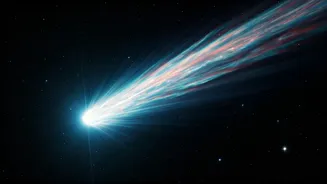
not bound to our Sun, proving they originated from interstellar space. The first, a strange, cigar-shaped object named 'Oumuamua, sped through in 2017, leaving scientists with more questions than answers. Then came 2I/Borisov in 2019, discovered by amateur astronomer Gennady Borisov. Unlike 'Oumuamua, Borisov looked and acted much more like a conventional comet, complete with a fuzzy halo of gas and dust, known as a coma. More recently, a third object, 3I/ATLAS, was detected in 2025, giving scientists another precious chance to study a sample from a different planetary system.
How We Know They're Not from Around Here
Identifying an object as interstellar comes down to one key factor: its trajectory. Objects within our solar system, from massive planets to tiny asteroids, follow elliptical orbits around the Sun. These interstellar visitors, however, travel on a different path. Their trajectories are hyperbolic, meaning they approach the Sun at such a high velocity that its gravity can bend their path but not capture them. They fly in, loop around the Sun, and head back out into the void, never to return. Comet 2I/Borisov, for instance, had an orbital eccentricity (a measure of how much an orbit deviates from a perfect circle) of about 3.36; anything over 1.0 is unbound from the Sun. This extreme speed is the calling card of a traveler from another star system.
Unpacking the Chemical Clues
The real excitement comes from analyzing what these comets are made of. By studying the light reflected from them and the gases they release when warmed by the Sun, scientists can determine their chemical composition. Comet 2I/Borisov offered a particularly fascinating glimpse. It was found to contain an unusually high concentration of carbon monoxide, much more than any comet observed at a similar distance from our Sun. This suggests it might have formed in an extremely cold environment, possibly around a red dwarf star—the most common type of star in our galaxy—which is smaller and cooler than our Sun. Another theory is that Borisov could be a fragment of a small planet that was rich in carbon monoxide.
A Glimpse into Other Worlds
Each interstellar comet is a time capsule, preserving the chemical makeup of the protoplanetary disk where it was born billions of years ago. By studying them, we are effectively sampling the building blocks of other solar systems. The composition of 2I/Borisov, with its high carbon monoxide levels, implies that the chemistry of its home system was very different from our own. The more recent visitor, 3I/ATLAS, has provided even more startling clues. Analyses from the James Webb Space Telescope suggest it has a very low abundance of the heavy isotope carbon-13 and high levels of heavy hydrogen, hinting it may have formed billions of years ago, possibly making it older than our own Sun and solar system.
The Coming Flood of Discoveries
For decades, the existence of interstellar objects was theoretical. Now, we have confirmed three in less than a decade. This is likely just the beginning. The Vera C. Rubin Observatory, an advanced new telescope in Chile, is expected to revolutionize this field. Its powerful camera and wide-field survey of the sky, known as the Legacy Survey of Space and Time (LSST), will be able to detect much fainter and faster-moving objects than ever before. Scientists predict that instead of just one or two chance discoveries, Rubin could find dozens of interstellar objects every year. This will allow for a population study, helping astronomers understand how common these visitors are, where they come from, and whether the building blocks of life are scattered across the galaxy.