


The Era of Hubble
For a generation, the Hubble Space Telescope defined our view of the cosmos. Its iconic deep field images, captured through days of staring at a tiny, seemingly empty patch of sky, revealed thousands of galaxies, each a pinprick of light from across cosmic
history. These images were revolutionary, pushing our timeline back to see galaxies that existed when the universe was in its infancy. Hubble, observing primarily in visible and ultraviolet light, showed us that the universe was teeming with structures far beyond our own Milky Way. However, its vision had limits. The very oldest, most distant galaxies are speeding away from us so fast due to the expansion of the universe that their light is stretched into longer, redder wavelengths—a phenomenon called redshift. This stretched light falls into the infrared part of the spectrum, much of which was beyond Hubble's keenest sight.
A New Eye on the Cosmos
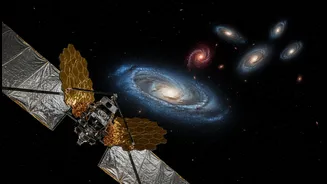
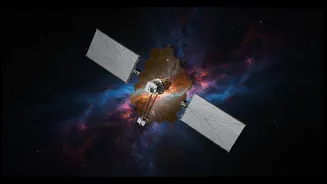
Enter the James Webb Space Telescope. Launched in 2021, Webb is not Hubble's replacement, but its powerful successor, designed specifically to capture the infrared light that Hubble could not. This gives it two immense advantages for studying deep time. First, its enormous, 6.5-meter-wide primary mirror—more than six times the area of Hubble's—can collect far more of this faint, ancient light. Second, its entire suite of instruments is optimized for infrared detection. This allows Webb to peer through the cosmic dust clouds that obscure the view for visible-light telescopes and to see the extremely redshifted light from the dawn of time. The result is that Webb can see objects up to 100 times fainter than Hubble and push our gaze further back, to just a couple hundred million years after the Big Bang.
From Blurry Smudges to Sharp Structures
The difference became immediately clear with Webb's first deep field image of the galaxy cluster SMACS 0723, released in July 2022. Where Hubble saw faint smudges after weeks of observation, Webb revealed thousands of sharp, distinct galaxies in just 12.5 hours of exposure time. The image is a showcase of gravitational lensing, where the massive cluster in the foreground bends and magnifies the light of even more distant galaxies behind it. Webb's infrared vision brought these lensed galaxies into sharp focus, revealing tiny, faint structures like star clusters that had never been seen before. Suddenly, the distant universe wasn't just a collection of faint red dots; it was filled with galaxies showing structure and complexity, offering astronomers a treasure trove of new data.
Pushing Back the Cosmic Dawn
With this new power, astronomers are rapidly pushing back the frontier of the known universe. Before Webb, the record for the most distant galaxy was held for years. In its first couple of years of operation, Webb has shattered that record multiple times. Teams like the JWST Advanced Deep Extragalactic Survey (JADES) have confirmed galaxies like JADES-GS-z14-0, which existed just 300 million years after the Big Bang. These aren't just faint curiosities; they are surprisingly large and bright. Standard pre-Webb theories of cosmology predicted that the first galaxies would be small, dim, and primitive. Instead, Webb is showing us a universe that was surprisingly active and capable of building large, luminous galaxies much earlier than anyone thought possible.
Rewriting the Textbooks
These discoveries are doing more than just filling in a timeline; they are forcing a rethink of how galaxies form and evolve. The surprising brightness and complexity of these early galaxies suggest that star formation in the early universe was far more vigorous and efficient than models had predicted. Scientists are now grappling with new questions: How did these galaxies accumulate so much mass so quickly? Did the first black holes play a bigger role than previously thought? Some studies even suggest the findings could challenge the standard model of cosmology, prompting new ideas about dark matter and the fundamental forces that shaped the cosmos. The telescope isn't just providing answers; it's revealing that we might not have been asking all the right questions.