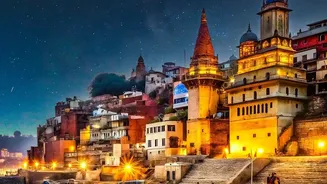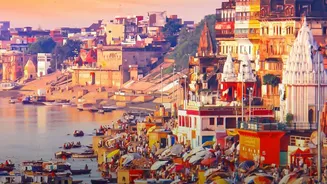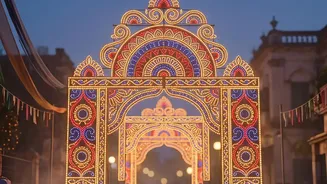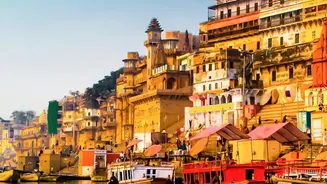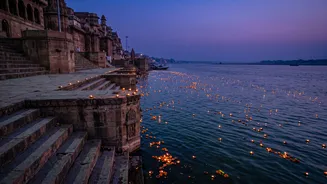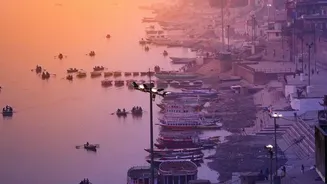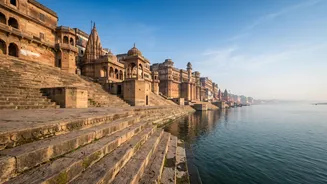






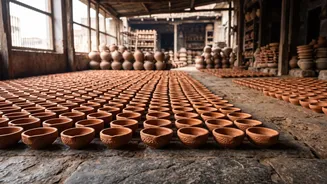
Varanasi's ghats, already aglow with a million earthen lamps for Dev Deepawali, now have a new storyteller. A spectacular laser show using waterfront mapping is transforming the ancient steps into a canvas for tales of gods and demons.
A Festival of Gods on the Ganga
Dev Deepawali, often
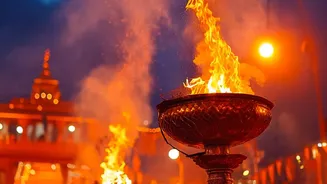
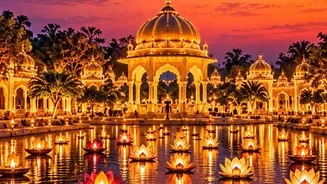
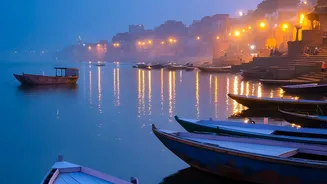
called the 'Diwali of the Gods', is a spectacle of faith that unfolds on the full moon night of the Hindu month of Kartik, fifteen days after Diwali. For 2026, this auspicious event will take place on the evening of November 24th. According to belief, on this night, the gods themselves descend to Earth to bathe in the holy Ganga. To welcome them, the entire 84-ghat stretch of Varanasi's riverfront is illuminated with millions of diyas, creating a breathtaking panorama of light that reflects and dances on the sacred waters. This river of light, combined with the resonant chanting of the grand Ganga Aarti, draws millions of pilgrims and travellers who seek to witness a tradition that is both profoundly spiritual and visually stunning.
Mythology Etched in Light
The core of the Dev Deepawali celebration is the commemoration of Lord Shiva's victory over the demon Tripurasura. Legend tells of three demon brothers who built three flying cities of gold, silver, and iron, using their power to torment the gods. Shiva, with a single arrow, destroyed all three cities, an event celebrated as Tripurotsav. This year, this very story and other tales from Hindu mythology are being narrated not just through chants, but through a high-tech laser and sound show. The historic facades of the ghats and adjacent forts, like Chet Singh Fort, serve as a massive, uneven screen for these projections, a technique known as projection or waterfront mapping.
The Technology Behind the Spectacle
Waterfront mapping is a sophisticated form of projection mapping that uses powerful lasers and projectors to cast images onto complex surfaces like buildings, and in this case, the sprawling, tiered ghats. Unlike a flat cinema screen, the software 'maps' every contour, step, and structure, allowing the projected light to fit perfectly onto the architectural canvas. This turns the physical environment itself into a dynamic part of the storytelling. While traditionally used for urban development visualization or environmental surveys, in Varanasi it is being repurposed as a new form of cultural and religious narration, bringing ancient stories to a modern audience in a visually compelling format.
Tradition and Innovation in Harmony
The introduction of laser shows and coordinated light displays represents a fascinating evolution of the festival. While the public spectacle of lighting millions of diyas is itself a relatively modern formalization of an older tradition, the laser show adds another layer of contemporary celebration. For many, it enhances the magical atmosphere, providing a grand, cinematic retelling of the myths that underpin the entire festival. Organizers see it as a way to engage younger generations and a growing number of international tourists. The result is a blend of quiet, personal devotion—the lighting of a single diya—and a grand, public display of technological artistry, all happening simultaneously along the timeless banks of the Ganga.
An Immersive Spiritual Experience
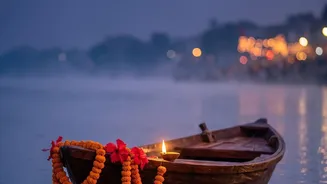
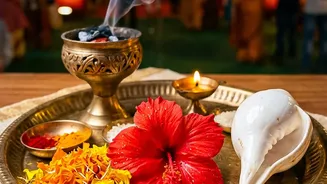
While the laser show provides a new focal point, the soul of Dev Deepawali remains in its core rituals. The festivities begin at dawn with Kartik Snan, a holy dip in the Ganga. Throughout the day, homes and temples are decorated, and in the evening, the collective lighting of lamps, known as Deep Daan, commences. The grand Ganga Aarti at Dashashwamedh Ghat is a powerful ceremony involving massive lamps, incense, and synchronized chanting by priests. Visitors can experience the full panorama from a boat on the river, a vantage point that captures the sheer scale of the lights, the energy of the crowd, and the new laser stories unfolding on the ghats, making for an unforgettable spiritual and sensory experience.