
Finding Your Urban Observatory
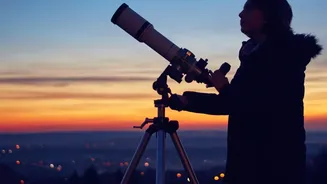
The biggest challenge for any city-based skywatcher is light pollution. The constant glow from streetlights, buildings, and vehicles can wash out all but the brightest stars. However, you don't need a remote mountaintop to see planets. The key is to find
the darkest possible spot in your vicinity. This could be a local park, a quiet rooftop, or even a balcony on a higher floor that is shielded from direct streetlights. Try to set up in the shadow of a building or a tree to block immediate glare. Once you've found your spot, give your eyes about 15-20 minutes to adjust to the darkness. Avoid looking at your bright phone screen during this time; it will reset your night vision.
Your Pocket Planetarium: Must-Have Apps
Modern technology has made stargazing incredibly accessible. Several smartphone apps act as a dynamic map of the sky, using your phone's sensors to identify celestial objects in real time. Simply point your phone towards the sky, and the app will show you what you're looking at. For a fantastic all-around experience, ‘Stellarium Mobile’ is a top choice, praised for its accurate sky simulation and huge database. Another excellent, user-friendly option is ‘SkyView Lite’, which uses augmented reality to overlay star and planet names onto your camera’s view. A unique option for Indian skywatchers is ‘Bhagol: Indian Sky Map,’ which presents the sky using the traditional Indian vocabulary of nakshatras and rashis. Most of these apps feature a red-light 'night mode' which helps preserve your dark-adapted eyesight.
Hunting the Giants: When and Where to Look
Throughout September 2026, both Jupiter and Saturn are favourably placed for viewing. Saturn will be visible for most of the night, rising in the evening and remaining in the sky until sunrise. It will appear as a steady, yellowish-white point of light. Jupiter makes its appearance in the early morning sky, rising a few hours before the Sun. It will be unmistakably bright, shining more brilliantly than any star. To find their exact locations, open your chosen sky app. It will guide you, showing you precisely where to look from your specific location and time. On September 26, look for Saturn shining near the bright full Harvest Moon.
Spotting the King: What to Look for with Jupiter
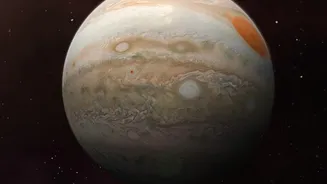
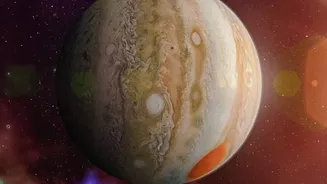
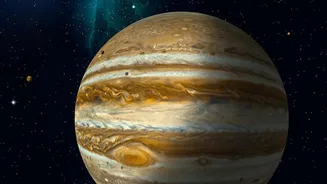
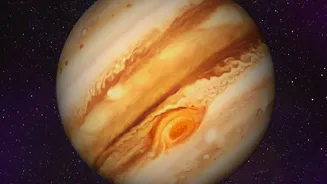
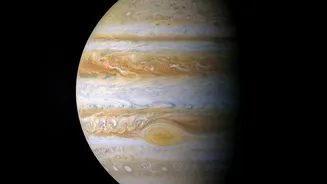
To the naked eye, Jupiter appears as a very bright, steady, star-like object. It doesn't twinkle as much as stars do, which is a good way to distinguish it. But the real magic begins with a simple pair of binoculars. You don't need an expensive telescope to have a breathtaking experience. When you focus your binoculars on Jupiter, you will not only see the planet as a distinct disc but may also spot up to four tiny points of light flanking it in a neat line. These are the Galilean moons: Io, Europa, Ganymede, and Callisto, the very same moons Galileo Galilei discovered in 1610. Seeing them for yourself is a thrilling connection to the history of astronomy.
Finding the Ringed Wonder: Viewing Saturn
Saturn is a dimmer, more subtly golden object compared to Jupiter. Once you locate it with your app, look for a point of light that holds steady. While you need a telescope to clearly resolve its famous rings, a good pair of binoculars held very steady might reveal that the planet is not perfectly round. Due to the rings, it can appear slightly oval or elongated. Seeing this subtle hint of its magnificent structure is a reward in itself. During September 2026, the rings are tilted quite narrowly towards us, offering a unique view. With powerful binoculars and a dark, stable sky, you might even be able to spot its largest moon, Titan, as a faint companion star.