




A Day Longer Than a Year
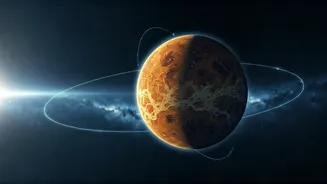
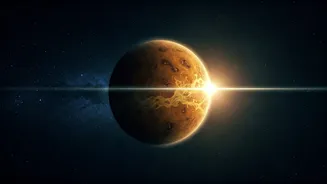
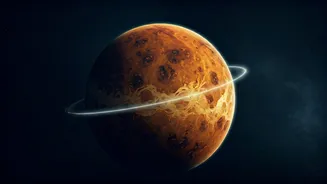
Let's get the main, mind-bending fact out of the way first. An orbital season, or a year, is the time it takes a planet to complete one full trip around the Sun. For Venus, this journey takes about 225 Earth days. A 'day,' however, is typically defined
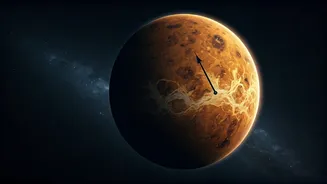
by how long a planet takes to spin once on its axis. And this is where Venus throws our earthly intuition out the window. It takes a staggering 243 Earth days for Venus to complete a single rotation. So, yes, you read that correctly: a day on Venus (243 Earth days) is longer than a year on Venus (225 Earth days). If you were standing on its surface, the planet would complete its entire orbit around the Sun before it finished one full spin. This unique characteristic makes Venus an outlier in our solar system, a place where the fundamental rhythms of time are completely alien to our own.
The Slow, Backward Spin
Venus's rotation isn't just incredibly slow; it's also backward. Most planets in our solar system, including Earth, spin counter-clockwise on their axis. This is known as prograde rotation. Venus, however, spins clockwise, a phenomenon called retrograde rotation. Uranus is the only other planet with a similarly strange orientation, though it's tilted so far on its side it essentially rolls along its orbit. Why the backward spin? Scientists have several theories. One leading idea is that Venus may have been struck by a massive asteroid or planetesimal early in its history, which either flipped it upside down or dramatically altered its rotational momentum. Another theory suggests that the gravitational pull of the Sun on Venus's incredibly thick atmosphere, combined with friction between its core and mantle, could have gradually slowed and then reversed its spin over billions of years. Whatever the cause, this retrograde motion has a profound effect on the planet's day-night cycle.
Sunrise in the West
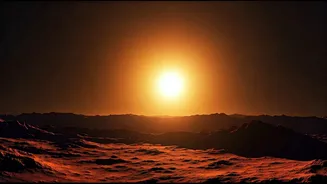
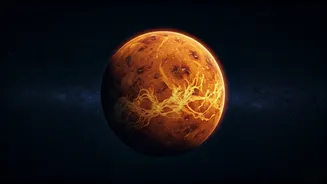
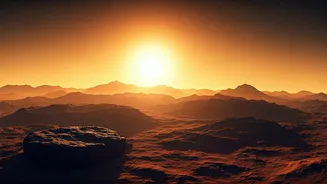
Because Venus spins backward, an observer on its surface would see the Sun rise in the west and set in the east. But don't expect a quick sunrise. Due to the combination of its slow, retrograde spin and its orbit around the Sun, the time from one sunrise to the next—what we call a solar day—is actually shorter than its rotational period. A solar day on Venus lasts about 117 Earth days. This means you'd experience roughly 58 days of continuous daylight followed by 58 days of crushing darkness. Of course, 'daylight' on Venus isn't what we're used to. The planet is shrouded in a permanent, dense blanket of sulfuric acid clouds. This atmosphere is so thick that it creates a runaway greenhouse effect, making Venus the hottest planet in the solar system with surface temperatures around 465°C—hot enough to melt lead. The light that filters through would be a dim, eerie, reddish-orange glow under a sky that never clears.
An Atmosphere in Charge
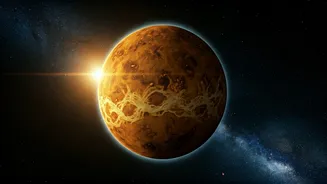
The extreme nature of Venus isn't just a collection of unrelated oddities; it's all interconnected. The planet's colossal atmosphere, 90 times denser than Earth's, is a dominant force. The extreme surface pressure is equivalent to being 900 metres underwater on Earth. This heavy atmosphere is thought to be a key reason for the planet's sluggish rotation. It acts like a brake, creating atmospheric tides that have likely dragged on the planet's surface for aeons, slowing its spin to a crawl. This thick, carbon dioxide-rich atmosphere also means there are no real 'seasons' in the way we understand them. While Venus has a slight axial tilt (about 3 degrees, compared to Earth's 23.5), its atmosphere is so effective at trapping and distributing heat that there's very little temperature variation between the equator and the poles, or between day and night. On Venus, it's always scorching hot, everywhere. The 'orbital seasons' mentioned in the headline are rendered meaningless by an atmosphere that imposes a single, brutal, and unchanging climate.