




The Hunt for Hidden Water
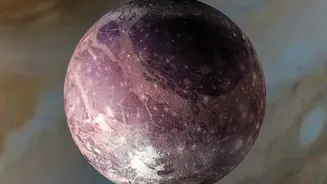
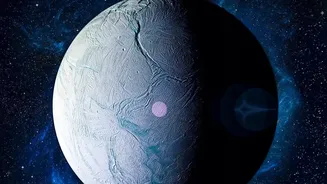
In the cold, outer reaches of our solar system, Europa and Enceladus stand out as tantalizing worlds. Scientists have strong evidence that both moons hide global oceans of liquid saltwater. Unlike Earth's oceans, these are not open to the sky but are trapped
beneath thick, icy shells. The gravitational pull from their giant host planets, Jupiter and Saturn, is thought to create enough tidal heat to keep the water from freezing solid. This combination of liquid water, potential chemical nutrients from the rocky core, and a source of energy makes these moons two of the most compelling places to look for extraterrestrial life. The challenge, however, is immense: confirming the oceans' properties and searching for biosignatures without ever touching the water itself.
Seeing Through Ice with Radar
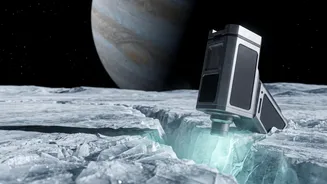
One of the most powerful tools for peering into these icy worlds is ice-penetrating radar. Think of it as a planetary-scale ultrasound. Spacecraft like NASA’s Europa Clipper, which launched in October 2024, are equipped with sophisticated radar instruments. Europa Clipper's instrument, called REASON (Radar for Europa Assessment and Sounding: Ocean to Near-surface), is designed to transmit radio waves that can penetrate up to 30 kilometres of ice. By analysing the returning echoes, scientists can map the thickness of the ice shell and, most importantly, detect the sharp boundary where ice meets liquid water. This technology, honed over decades of studying Earth's own ice sheets in Antarctica, will provide the first direct look at the structure beneath Europa's frozen crust.
Magnetic Fields as a Telltale Sign
Another clever technique involves using magnetic fields. As Europa orbits Jupiter, it passes through the gas giant’s powerful magnetic field. If a salty, electrically conductive ocean exists beneath the ice, it should create its own secondary, induced magnetic field in response. The Europa Clipper carries a sensitive magnetometer on an 8.5-meter boom to measure these subtle magnetic disturbances. By carefully measuring the strength and orientation of this induced field during multiple flybys, scientists can not only confirm the ocean's existence but also estimate its depth and salinity—key factors in determining its potential habitability. An instrument called PIMS helps distinguish the ocean's magnetic signature from interference caused by charged particles in the space around the moon.
Sniffing Geysers for Clues
While Europa's secrets are locked tightly under ice, Enceladus offers a more direct sample. In 2005, the Cassini spacecraft discovered massive plumes of water vapor and ice particles erupting from fissures, or "tiger stripes," near Enceladus's south pole. These geysers shoot material directly from the subsurface ocean into space, providing a unique opportunity for a spacecraft to 'taste' its contents without landing. Instruments called mass spectrometers, like MASPEX on Europa Clipper and those planned for future Enceladus missions, can fly through these plumes and analyse their chemical makeup. They hunt for organic compounds, salts, and other molecules that could indicate chemical processes—or even biological activity—happening in the dark ocean below.
Putting It All Together
No single instrument tells the whole story. The strategy is to combine data from multiple sources to build a comprehensive picture. Gravity science will measure how the moons flex under their planet's pull, which can reveal the presence of a liquid layer. Thermal imagers will scan for warm spots on the surface where the ocean might be closer than expected. Spectrometers will map the surface composition, looking for ocean materials that may have reached the surface. Together, these orbital techniques allow scientists to act as cosmic detectives, gathering diverse lines of evidence from hundreds of kilometres away. While missions like Europa Clipper are not designed to find life directly, they will determine if these alien oceans possess the right ingredients to support it.