



An Encore for a Legendary Spacecraft
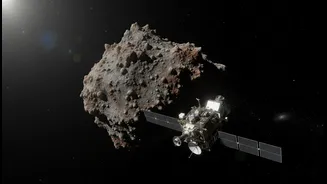
First, a quick reintroduction to our hero. The Hayabusa2 probe, operated by the Japan Aerospace Exploration Agency (JAXA), became famous when it successfully collected samples from the asteroid Ryugu and returned them to Earth in 2020. But instead of
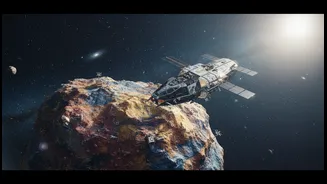
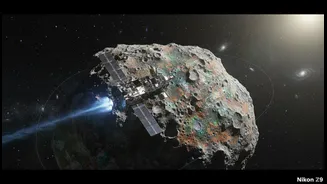
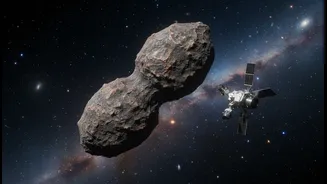
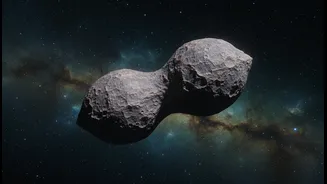
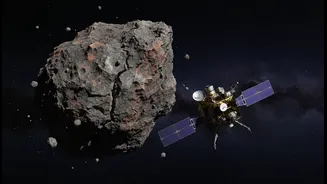
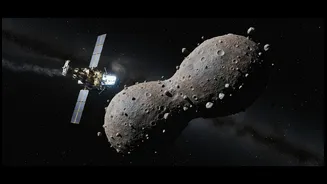
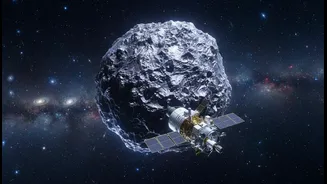
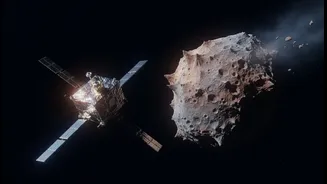
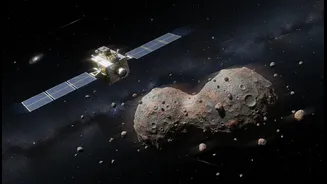
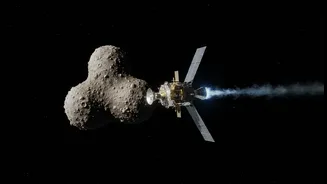
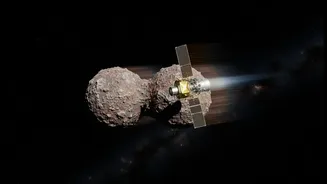
retiring, the resilient spacecraft was given an extended mission. Its latest assignment was a close encounter with a near-Earth asteroid officially named 98943 Torifune (also known as 2001 CC21). On July 5, 2026, Hayabusa2 executed a high-speed flyby, getting as close as 800 metres to the 450-metre-wide space rock while travelling at five kilometres per second. The manoeuvre was a stunning success, with the probe capturing detailed images revealing Torifune is a 'contact binary' — two asteroids that have gently fused into a snowman-like shape.
The Immense Challenge of Finding Your Way
So, what makes this flyby a great lesson in navigation? Imagine trying to hit a moving coin in Delhi with a dart thrown from Mumbai. Now, imagine both the dart and the coin are moving at thousands of kilometres per hour in the vacuum of space. That’s the scale of the problem. Space has no GPS. Mission controllers rely on a combination of techniques. The primary method involves sending radio signals from Earth's Deep Space Network to the spacecraft and measuring how long they take to return. This provides the range (distance) and range rate (velocity), but it's not enough for pinpoint accuracy, especially when the target asteroid's exact path has its own uncertainties.
The Precision Toolkit
This is where optical navigation becomes crucial. As Hayabusa2 got closer to Torifune, it began taking images of the asteroid against the backdrop of distant stars. By comparing the asteroid's position relative to these fixed star patterns, navigators on Earth could refine their understanding of both the spacecraft's path and the asteroid's orbit with incredible precision. For its even more daring touchdown on Ryugu years earlier, Hayabusa2 used a suite of tools including a laser altimeter (LIDAR) to measure distance and deployed reflective target markers on the surface to act as artificial landmarks, allowing for an autonomous landing with an error margin of just one metre. While a landing wasn't part of the Torifune flyby, the same principles of using onboard sensors to make last-minute adjustments were essential.
Why This Flyby Was So Difficult
The Torifune encounter was what's known as a 'high-speed flyby'. Unlike the earlier Ryugu mission, where Hayabusa2 spent a year and a half in orbit, this was a fleeting pass. The spacecraft had only a very short window to gather its scientific data. This made the navigation extremely challenging. Because asteroids are small and dark, Hayabusa2 could only get a clear visual a few days before the encounter, requiring rapid, last-minute trajectory corrections. Successfully guiding the probe so close without a collision, at such a high relative speed, was a deliberate and risky test of JAXA's navigation capabilities.
From Asteroids to Planetary Defence
Mastering this level of precision isn't just for scientific curiosity. This flyby was a key technology demonstration for planetary defence. To deflect a potentially hazardous asteroid, we would first need to guide a spacecraft to it with extreme accuracy. The techniques honed during the Torifune flyby are exactly what would be needed for a future mission designed to impact an asteroid and alter its course. The flyby served as a rehearsal for this kind of rapid reconnaissance. Looking ahead, Hayabusa2's journey isn't over. It's now on its way to a final rendezvous in 2031 with 1998 KY26, a tiny, fast-spinning asteroid just 11 metres in diameter, where its hard-won navigation skills will be put to the ultimate test.