






An Unexpected Climate Connection
For decades, scientists have identified several key drivers of the Indian monsoon. Factors like the El Niño-Southern Oscillation (ENSO), the warming of the Tibetan plateau, and the Indian Ocean Dipole are all well-known influencers of when the rains will
arrive and how intense they will be. These elements form the basis of monsoon forecasting, a critical exercise for India's agriculture, economy, and daily life. However, recent research has thrown a fascinating new variable into the mix, suggesting that events at the South Pole have a direct and profound link to our subcontinent's life-giving rains. This long-distance relationship, known in climate science as a 'teleconnection', challenges our traditional understanding and opens up new avenues for predicting the monsoon's behaviour.
A Story Written in Ancient Leaves
The most compelling evidence for this connection comes from a surprising source: 34-million-year-old fossilised leaves discovered in Nagaland. A 2025 study led by researchers from the Birbal Sahni Institute of Palaeosciences and the Wadia Institute of Himalayan Geology analysed these ancient leaves to reconstruct the climate of that era. Their findings, published in a leading palaeoclimatology journal, revealed that Northeast India once experienced a much wetter and warmer climate. Crucially, the timing of this ancient, super-charged monsoon coincided exactly with the period when Antarctica began to freeze over, forming its massive ice sheets. This discovery provided the first concrete link between the two seemingly disparate phenomena.
How a Frozen Continent Makes Waves
The mechanism behind this connection lies in a planet-wide atmospheric feature called the Intertropical Convergence Zone (ITCZ), a belt of low pressure and heavy rainfall that encircles the Earth near the equator. The study concluded that as Antarctica's ice sheets grew 34 million years ago, it dramatically cooled the Southern Hemisphere. This cooling pushed the ITCZ northwards, shifting this major rain belt directly over the Indian subcontinent and intensifying the monsoon rains in the process. In essence, the formation of ice at the South Pole reshaped global wind and rainfall patterns, setting in motion the monsoon system that we recognise today. This long-distance influence is not just a relic of the past; modern studies also highlight how changes in Antarctic sea ice can modulate atmospheric pressure systems like the Mascarene High, which is vital for driving monsoon winds towards India.
What This Means for India Today
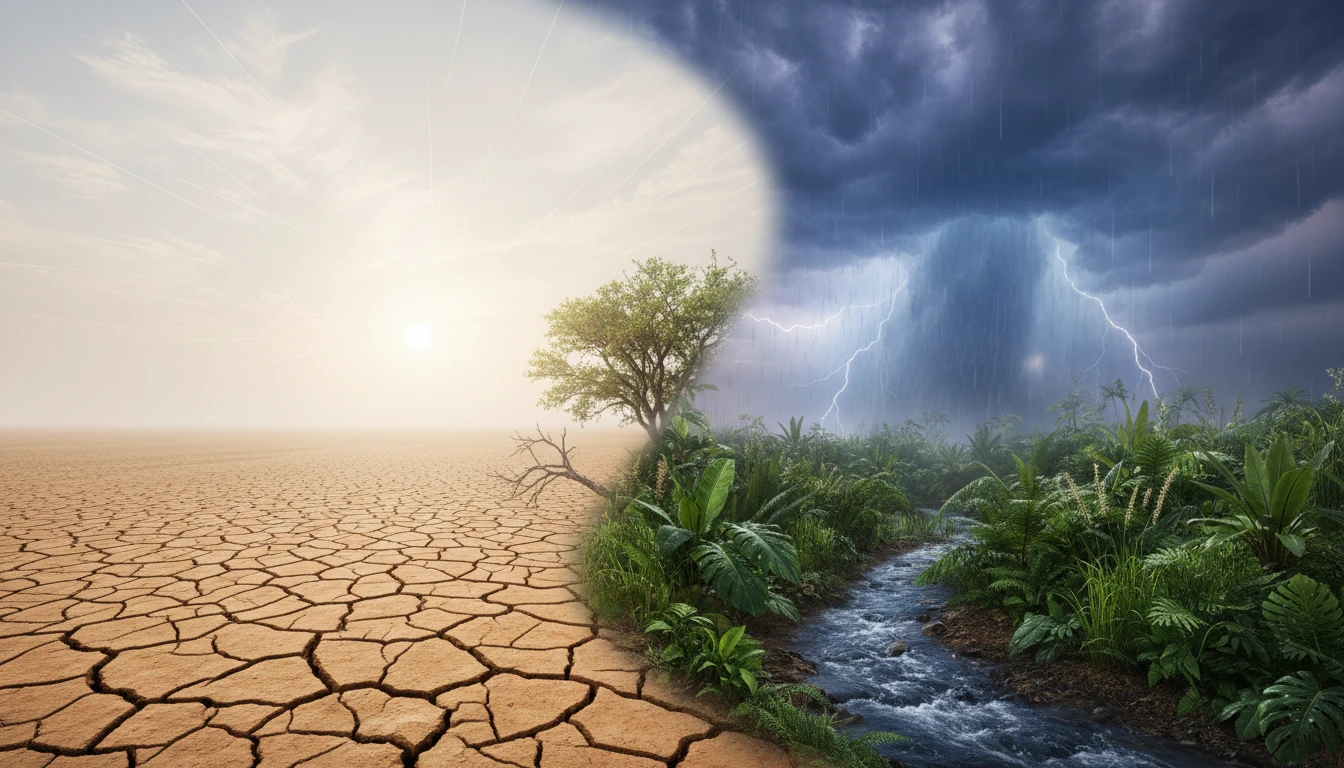
This ancient story carries a critical warning for the present. Just as the growth of Antarctic ice shifted the monsoon, the current melting of that same ice due to global warming could disrupt it once again. Recent studies suggest that an increase in freshwater from melting Antarctic ice can alter sea surface temperatures in the Pacific and Indian Oceans, which in turn influences monsoon strength. Some models indicate that this could even increase Indian summer monsoon rainfall, but with greater unpredictability. For a nation where millions depend on rain-fed agriculture, any shift in monsoon patterns brings the risk of more frequent and extreme droughts and floods. The erratic patterns seen in recent years, with some parts of India receiving excess rain while others remain dry, could be a sign of these larger global shifts at play.