


A Groundbreaking Discovery From Orbit
While the world celebrated Chandrayaan-3's historic landing, its predecessor, the Chandrayaan-2 orbiter, has continued to circle the Moon since 2019, diligently gathering data. Recent findings from this resilient mission have provided some of the strongest
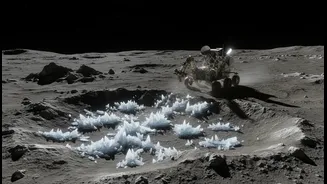
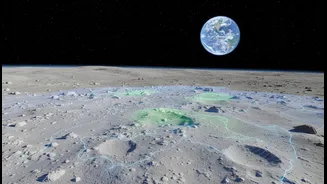
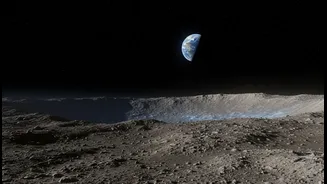
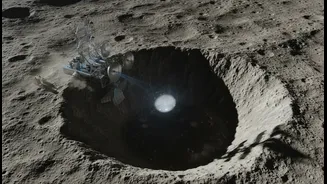
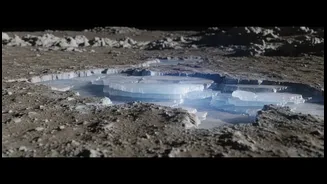
evidence yet for the presence of ice buried beneath the lunar surface. Scientists from the Physical Research Laboratory (PRL), Ahmedabad, analysing the orbiter's radar observations, have identified compelling signatures of subsurface ice in the Moon’s south polar region. The study points specifically to 'doubly shadowed craters'—frigid pockets within larger, permanently shadowed craters, where temperatures plummet to around -248 degrees Celsius, creating perfect conditions to preserve ice over billions of years.
ISRO’s Unique 'X-Ray Vision' for the Moon
The hero of this story is the Dual-Frequency Synthetic Aperture Radar (DFSAR) onboard Chandrayaan-2. It's no ordinary camera. As the first fully polarimetric radar system to orbit the Moon, it possesses a unique capability. The instrument sends out microwave signals in two different frequency bands, L-band and S-band. While S-band is excellent for mapping the surface, the longer wavelength of the L-band can penetrate several metres below the ground, offering a form of 'X-ray vision' into the lunar subsurface. This ability to see what lies beneath the regolith (lunar soil) is crucial, as much of the Moon’s precious water ice is thought to be mixed with soil or buried under layers of dust, hidden from optical instruments.
The Scientific Detective Work
For years, a major challenge for scientists has been distinguishing the radar signature of water ice from that of very rough, rocky terrain. Both can scatter radar signals in confusingly similar ways. The Indian scientific team developed a clever method to solve this ambiguity. They analyzed two specific properties of the reflected radar waves: the Circular Polarisation Ratio (CPR) and the Degree of Polarisation (DOP). By searching for areas that showed both a high CPR value and a very low DOP value, they could filter out the 'false positives' from rocks. This specific combination is considered a refined diagnostic tool for 'volumetric scattering'—a telltale sign that the radar waves have bounced around within a material like ice, rather than just bouncing off a hard surface. Strong evidence was found in four craters, with a 1.1 km wide crater inside the larger Faustini crater being a prime candidate.
Why Finding Buried Ice Is a Game-Changer
Confirming the location and nature of this subsurface ice is more than just a scientific curiosity; it is a critical step for the future of human space exploration. This ice represents a vast, untapped resource. It can be melted into drinking water for astronauts, separated into oxygen for breathing, and, crucially, processed into hydrogen and oxygen for rocket propellant. The ability to source water and fuel directly from the Moon—a concept known as In-Situ Resource Utilisation (ISRU)—would dramatically reduce the cost and complexity of future missions. Instead of launching everything from Earth, a lunar base could become a self-sufficient outpost and a refuelling station for deeper voyages into the solar system, for instance to Mars. This work by ISRO is essentially creating a resource map for humanity's return to the Moon.
Cementing India’s Lunar Legacy
This radar discovery is the latest chapter in India’s compelling lunar saga. It began with the Chandrayaan-1 mission, whose instruments first confirmed the presence of water molecules on the Moon. It was followed by the triumph of Chandrayaan-3, which made India the first nation to soft-land near the lunar south pole. Now, the persistent work of the Chandrayaan-2 orbiter adds another layer to this legacy, demonstrating India's prowess not just in landing but in conducting high-level, sustained science from orbit. By developing unique instruments and innovative analytical methods, ISRO is not just participating in the global race to the Moon; it is providing foundational knowledge that will benefit all spacefaring nations and solidify its position as a leader in lunar exploration.