

Meet the Super-Earths
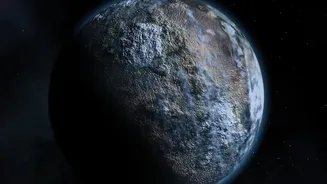
Before diving into the discovery, let's get acquainted with these celestial objects. 'Super-Earth' is a classification for planets that are more massive than Earth but lighter than the ice giants in our solar system, like Neptune and Uranus. Intriguingly,
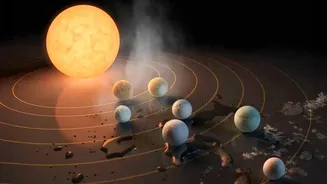
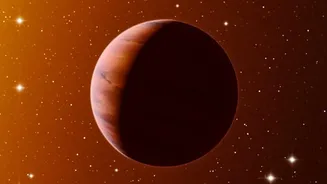
our solar system doesn't have a Super-Earth, yet they appear to be one of the most common types of exoplanets—planets outside our solar system—in the Milky Way galaxy. Their size and composition vary wildly, from rocky worlds to those with thick, gassy envelopes. This diversity makes them fascinating targets for astronomers, who are keen to understand which of these worlds might possess the right conditions for life.
A Glimpse of Water Across the Stars
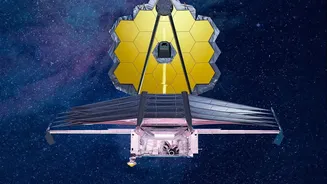
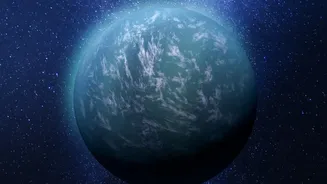
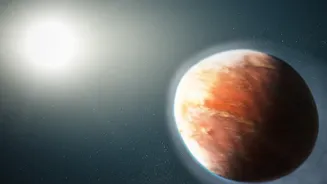
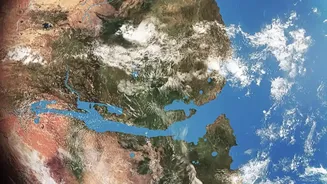
The headline-making news comes from JWST's observations of several exoplanets, most notably K2-18 b, a Super-Earth located about 120 light-years away. Using its powerful instruments, the telescope detected not just water vapour, but also carbon-bearing molecules like methane and carbon dioxide in the planet's atmosphere. The presence of these specific gases, combined with a shortage of ammonia, strongly supports the hypothesis that K2-18 b could be a 'Hycean' world—a theoretical type of planet with a hydrogen-rich atmosphere covering a globe-spanning ocean of liquid water. This doesn't confirm an ocean, but it's the most compelling evidence to date. Another Super-Earth, 55 Cancri e, has also shown tantalizing signs of a substantial atmosphere, possibly rich in carbon dioxide or carbon monoxide, which is a major discovery for a rocky planet so close to its star.
How Webb Peeks into Alien Atmospheres
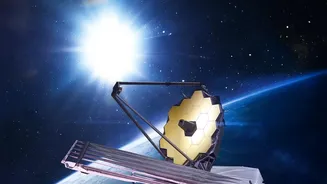
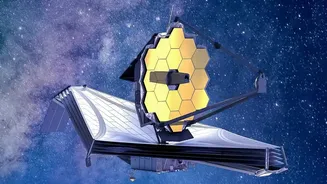
So, how does JWST manage this incredible feat from millions of kilometres away? The technique is called transit spectroscopy. As an exoplanet passes in front of its host star from our perspective, a tiny fraction of the starlight filters through the planet's atmosphere. Different gas molecules absorb specific colours, or wavelengths, of light. By analyzing the starlight that reaches the telescope, astronomers can identify these missing slivers of light and deduce which gases are present, creating a chemical fingerprint of the planet's atmosphere. JWST's unparalleled sensitivity to infrared light, which is invisible to the human eye, makes it exceptionally skilled at detecting the signatures of molecules like water, methane, and carbon dioxide.
Habitable, But Not Necessarily Inhabited
Finding water vapour is a monumental step, but it’s crucial to manage expectations. K2-18 b orbits within its star's 'habitable zone,' the region where temperatures could allow liquid water to exist on a planet's surface. However, the term 'habitable' simply refers to the potential for liquid water, not a guarantee of Earth-like conditions. A Hycean world, for instance, would be very different from our own planet, with a dense hydrogen atmosphere and potentially a boiling ocean. Furthermore, on some incredibly hot planets like 55 Cancri e, the atmosphere might be a secondary envelope created by gases venting from a magma ocean, not a life-sustaining environment. These findings represent a crucial piece of the puzzle, not the final picture.
A New Era of Exploration
For decades, scientists have moved from discovering exoplanets to being able to confirm their existence. Now, thanks to the James Webb Space Telescope, we have firmly entered the era of atmospheric characterization. Each discovery, whether it's the potential for a water ocean on K2-18 b or the detection of a secondary atmosphere on 55 Cancri e, pushes the boundaries of our knowledge. JWST is not just finding new worlds; it's beginning to tell us what they are like. The telescope's ability to inventory the chemical makeup of these distant atmospheres is transforming the search for habitable environments, moving it from theoretical models to tangible, observational science.