


A New Eye on the Cosmos
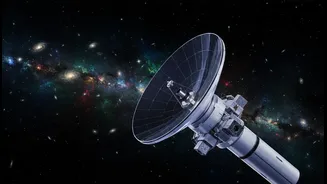
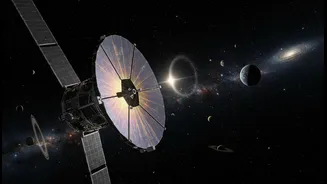
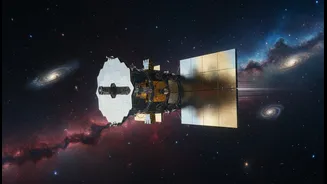
Named after Nancy Grace Roman, NASA's first chief of astronomy and the “Mother of Hubble,” the Roman Space Telescope is the agency's next great observatory. Scheduled to launch by August 2026, it carries a 2.4-metre mirror, the same size as the Hubble Space Telescope's.
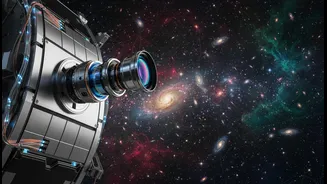
But to call it a twin of Hubble would be a massive understatement of its unique power. Roman's greatest strength isn't just its sharp vision, but the sheer breadth of it. Its Wide Field Instrument will give it a field of view 100 to 200 times larger than Hubble’s infrared camera. Imagine looking at the night sky through a narrow tube versus a massive panoramic window; that’s the difference Roman brings to the table. This allows it to map the sky up to 1,000 times faster than Hubble, turning years of work into a matter of days.
Lifting the Primordial Fog
One of Roman’s key targets is the “cosmic dawn,” the period a few hundred million years after the Big Bang when the very first stars and galaxies lit up. In its infancy, the universe was filled with a thick fog of neutral hydrogen gas that absorbed starlight, making the cosmos opaque. Over time, the intense radiation from the first stars and galaxies gradually ionized this gas, clearing the fog and making the universe transparent, as it is today. Scientists are still debating what exactly drove this monumental change. Was it countless small galaxies or a few very large, brilliant ones? The James Webb Space Telescope (JWST) can study individual early galaxies in stunning detail, but its narrow view makes it hard to see the big picture. Roman, with its vast survey capabilities, will find and catalogue thousands of these primordial galaxies, giving scientists the statistical data needed to finally understand how this cosmic transition happened.
Surveying the Dark Side
Beyond the early universe, Roman’s main mission is to tackle two of the biggest mysteries in physics: dark energy and dark matter. Together, these enigmatic phenomena are believed to make up about 95% of the cosmos, yet we know almost nothing about them. Dark energy is the name given to the mysterious force causing the expansion of the universe to accelerate. Roman will probe it by creating a massive 3D map of the universe, surveying hundreds of millions of galaxies and thousands of distant supernovae. By measuring how the distribution of galaxies has changed over cosmic time and how their light has been stretched by the expanding universe, scientists can chart the history of cosmic expansion with unprecedented precision. This will help determine if dark energy is a constant force or something that has changed over the billions of years since the Big Bang.
A Universe of New Worlds
While mapping the grandest structures of the cosmos, Roman will also be on the lookout for some of the smallest: planets orbiting other stars. It will conduct a massive survey of the central bulge of our Milky Way galaxy, using a technique called gravitational microlensing. This method can detect planets far from their star, and even rogue planets that drift through space without a host star at all—worlds that are nearly impossible to find with other techniques. Scientists anticipate that Roman could discover thousands of new exoplanets, from gas giants down to rocky worlds smaller than Earth, providing a new census of the planets in our galaxy. It will also carry a technology demonstrator called a coronagraph, an instrument designed to block the overwhelming glare of a star to directly image the planets orbiting it.