

The Ultimate Supply Chain Problem
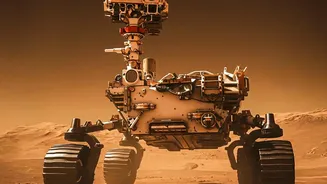
The core issue facing mission planners is mass. Every kilogram sent from Earth to Mars is astronomically expensive and logistically complex. A mission lasting several years would require an impossible amount of pre-packaged food. NASA estimates an astronaut
consumes roughly 2.5 kg of food per day, including packaging. For a crew of four on a three-year mission, that's nearly 11,000 kg of meals alone. This makes relying on resupply missions from Earth completely impractical for a sustainable presence. The only viable solution is what experts call In-Situ Resource Utilization (ISRU) — essentially, living off the land. Growing food locally is the most critical application of this principle, turning a dependency on Earth into a self-sufficient, bioregenerative life support system that also produces oxygen and helps recycle waste.
The Poisoned Ground
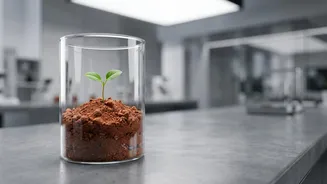
The first and most significant hurdle is that Martian 'soil' is not soil at all. It's regolith: a fine, lifeless dust of crushed rock, utterly devoid of the organic matter and beneficial microbes that terrestrial plants depend on. Worse, the regolith is toxic. It is saturated with perchlorate salts, which are hazardous to humans and plants alike. At concentrations of up to 1%, these compounds disrupt thyroid function and would need to be meticulously removed from any soil used for agriculture. Even if the perchlorates are washed out, the process can release other harmful metals in the regolith, potentially creating a new layer of toxicity for plants. This means any Martian farm would first require an intensive soil manufacturing or detoxification plant, a complex industrial process to be performed millions of miles from Earth.
An Atmosphere of Hostility
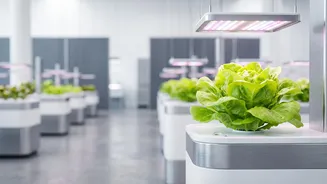
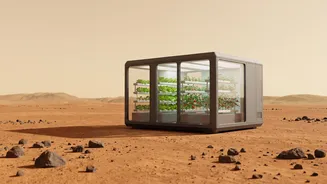
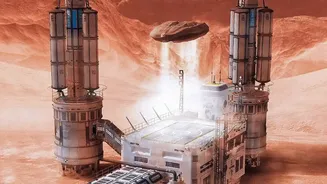
Even with perfect soil, growing anything in the open on Mars is impossible. The planet's atmosphere is less than 1% as thick as Earth's, offering no protection from sterilizing cosmic radiation. Temperatures can plunge well below freezing every night. This means any Martian agriculture must take place within highly controlled, pressurized greenhouses. But these structures present their own immense challenges. They would need to be shielded from radiation and potential micrometeorite impacts, which might mean building them underground. This, however, blocks out sunlight, necessitating powerful and energy-intensive artificial lighting systems like LEDs. A crop failure on Mars wouldn't just be a financial loss; it could be a catastrophic event leading to starvation, as there are no emergency imports from a neighboring region.
From Lab Benches to Red Dirt
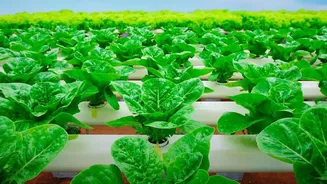
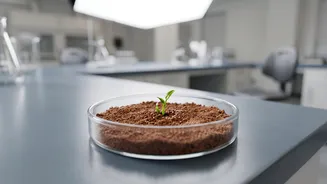
Researchers are tackling these problems head-on. Numerous experiments have attempted to grow crops like lettuce, radishes, and turnips in Martian soil simulants. Early results showed that while some plants can grow, they are often stunted and underdeveloped compared to their Earth-grown counterparts. The key seems to be amending the regolith. Studies have shown that adding nutrients, using precursor crops like alfalfa to enrich the simulant, or introducing beneficial fungi can improve plant health and yield. Other promising avenues involve soilless methods like hydroponics and aeroponics, which bypass the regolith problem entirely but require large amounts of carefully managed water and nutrients. Scientists are also exploring genetically engineering 'super plants' with traits borrowed from extremophiles—organisms that thrive in Earth's harshest environments—to make them more resilient to drought and cold.