



The Sun's Unpredictable Temper
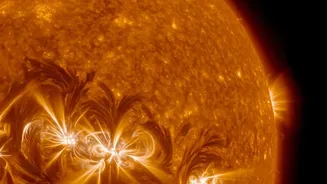
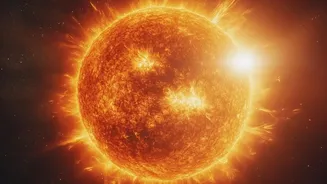
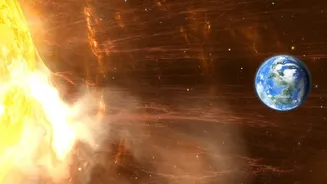
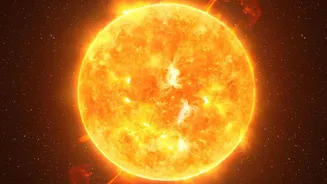
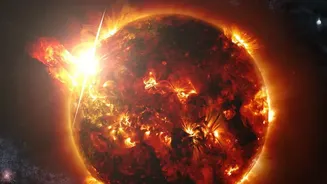
Our star is a dynamic and sometimes violent entity. While it provides the light and warmth necessary for life, it also has a turbulent side. This manifests as space weather, driven by massive explosions on the Sun's surface. The headline events are solar
flares and coronal mass ejections (CMEs). A solar flare is an intense, brilliant flash of radiation. A CME, on the other hand, is a colossal cloud of magnetised plasma and particles hurled into space at millions of kilometres per hour. While often linked, they are different phenomena. The flare is the flash of light; the CME is the cannonball. It is the Earth-directed CME that poses the most significant threat to our technology-dependent society, capable of causing widespread power blackouts, damaging critical satellites, and disrupting GPS and communication signals.
The Genius of Blocking the Sun
Trying to spot a CME leaving the Sun is like trying to see a moth flying next to a powerful searchlight. The Sun's own brightness is so overwhelming that it completely blinds us to the much fainter corona—the Sun's outer atmosphere where these eruptions originate. This is where the coronagraph comes in. Invented by Bernard Lyot in 1931, a coronagraph is a special telescope that uses a small disk, called an occulting disk, to block the main face of the Sun. This creates an artificial eclipse, allowing the incredibly faint light of the corona to be seen and studied. To get a clear view, free from the scattering effects of Earth's atmosphere, these instruments are placed on satellites far from Earth, giving us a front-row seat to the Sun's activity.
Our Eyes in the Sky
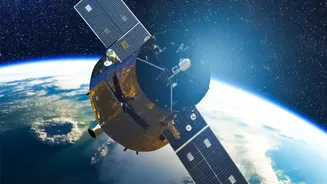
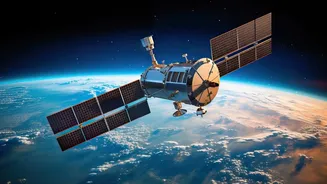
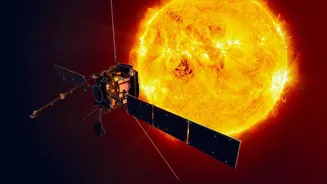
A fleet of satellites acts as our early warning system. For decades, the workhorse has been the LASCO instrument on the joint NASA/ESA SOHO satellite, launched in 1995. However, a new generation of more advanced coronagraphs is now operational. NOAA's GOES-19 satellite carries the Compact Coronagraph (CCOR-1), which provides images of the corona every 15 minutes. Further out, at a gravitationally stable point 1.5 million km from Earth called L1, other observatories keep watch. India's Aditya-L1 mission, which arrived at L1 in early 2024, carries the Visible Emission Line Coronagraph (VELC) to study the corona in great detail. Missions like ESA's Proba-3 are even experimenting with using two separate satellites flying in precise formation, with one acting as the occulter for the other 150 metres away, to get an even clearer view of the inner corona.
From Image to Forecast
When a coronagraph detects a CME, it's a race against time. Forecasters at agencies like NOAA’s Space Weather Prediction Center (SWPC) receive the images within minutes. They analyse the data to determine the CME's size, speed, and direction. By observing its path as it expands away from the Sun, they can calculate if it is on a collision course with Earth. This data is fed into sophisticated computer models, like the WSA-Enlil model, which predict the CME's arrival time and potential intensity. This gives power grid operators, satellite controllers, airlines, and other critical industries anywhere from a few hours to three days of advance warning to take protective measures, such as powering down sensitive electronics or rerouting flights.