







What Did Hubble Actually See?
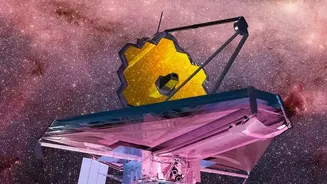
The Hubble Space Telescope has identified a colossal, 10-sided atmospheric wave, or 'decagon', encircling Saturn's south pole. This is the first time a large, regular-sided jet stream pattern has been confirmed in the planet's southern hemisphere. The structure
is a massive, meandering wave in the atmosphere, not a solid object. It was first hinted at in images from ground-based observatories in 2024, but Hubble's sharp, unobstructed view from space provided the high-resolution confirmation that scientists needed. This decagon appears to be a relatively new phenomenon; it was not seen by the Cassini spacecraft, which orbited Saturn from 2004 to 2017.
A Tale of Two Polygons
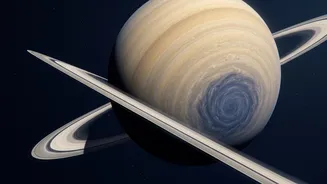
This new discovery immediately draws comparisons to Saturn's most famous feature: the persistent, six-sided hexagon at its north pole. The northern hexagon has been a subject of fascination since the Voyager probes first spotted it over 40 years ago. While the new decagon is a geometric counterpart, it's not a perfect twin. For one, it has ten sides instead of six. It is also located at a slightly different latitude than its northern sibling. Scientists are particularly intrigued because while the hexagon appears to be a stable, long-term feature, the decagon seems to be a new development, with observations showing it strengthening since it was first traced back to 2023. This gives researchers a rare opportunity to watch a giant planetary weather pattern form in real-time.
What Causes These Bizarre Shapes?
While the exact mechanisms are still being debated, these planetary polygons are born from the complex fluid dynamics in Saturn's atmosphere. The prevailing theories suggest they are caused by instabilities in powerful jet streams. Essentially, deep atmospheric flows and smaller storms can 'pinch' a main jet stream, forcing it into a polygonal shape. Laboratory experiments have recreated similar shapes by rotating a circular tank of liquid at different speeds, which mimics the varying wind speeds at different latitudes on Saturn. The number of sides—six for the hexagon, ten for the decagon—is believed to relate to the specific speed, width, and shear of the jet stream that carries it. The different shapes on the two poles suggest that the atmospheric conditions are not identical in the north and south.
Why Now? The Importance of a Long Gaze
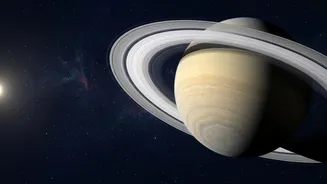
One reason this discovery is happening now is a matter of orbital mechanics. Saturn has a long, 29-year orbit and is tilted on its axis, meaning its poles are hidden from Earth's view for long stretches of time. The south pole has only recently come back into a favorable viewing position after being obscured for years. This discovery was made possible by the Hubble's Outer Planet Atmospheres Legacy (OPAL) program, which has been taking annual 'portraits' of the outer planets for over a decade. This consistent, long-term monitoring allows scientists to spot changes that might otherwise be missed. The OPAL program creates a consistent, year-over-year dataset that turns faint hints of a pattern into a measurable, confirmed discovery.