






The Core Paradox: A Day Longer Than a Year
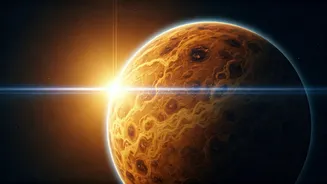
Let's get straight to the unbelievable numbers. A year on Venus—the time it takes to complete one full orbit around the Sun—is about 225 Earth days. That’s its entire solar journey. However, a single day on Venus—the time it takes for the planet to complete one full rotation
on its axis—is a whopping 243 Earth days. That’s right, it takes longer for Venus to spin once than it does for it to travel all the way around the Sun. If you were standing on Venus, you would celebrate your first birthday before you’d even experienced a full day-night cycle from the perspective of the planet's own spin.
How Is This Even Possible?
To understand this, we need to separate two distinct motions: rotation and revolution. Revolution is the planet’s journey around the Sun, which defines its year. Rotation is the planet’s spin on its own axis, which defines its day. On Earth, these two concepts are neatly aligned: our planet spins quickly (a 24-hour day) while it orbits the Sun more slowly (a 365-day year). Venus completely flips this script. Its orbit is relatively fast, but its spin is agonisingly slow. It’s like a race between two runners, where the one on the long, outer track (the year) finishes before the one spinning in place at the centre (the day) has even completed a single turn.
The Retrograde Twist
As if a super-long day wasn't strange enough, Venus also spins backwards. Most planets in our solar system, including Earth, rotate in a counter-clockwise direction on their axis (prograde motion). Venus rotates clockwise (retrograde motion). This means that if you could survive on its surface, you would see the Sun rise in the west and set in the east. This backward, sluggish spin is a key piece of the puzzle. The combination of its orbital direction and its slow, backward rotation creates an even stranger phenomenon: the length of a solar day.
But What About a Sunrise?
We’ve established that a 'sidereal day' (one full 360-degree rotation) is 243 Earth days. But what about a 'solar day'—the time from one sunrise to the next? Because Venus is orbiting the Sun while it slowly spins backward, the time between sunrises is different. The two motions partially cancel each other out, resulting in a solar day that is 'only' about 117 Earth days long. So, while a single spin takes forever, you’d see two sunrises for every one trip around the Sun. It’s a cosmic paradox: one Venusian year contains roughly two Venusian solar days, even though a single rotation takes longer than the year itself.
Why Is Venus So Strange?
Scientists don't have a single, definitive answer, but there are two leading theories. The first involves a colossal impact. Early in its history, Venus may have been struck by a massive planet-sized object that was powerful enough to not just tilt its axis but completely reverse its spin, slowing it down dramatically in the process. The second theory points to Venus's incredibly dense atmosphere. This thick, heavy blanket of gas, 90 times more massive than Earth's, might have created powerful atmospheric tides. Over billions of years, friction between the churning atmosphere and the solid planet could have acted as a brake, slowing its rotation to the crawl we see today and possibly even flipping it over.
A Truly Alien World
This bizarre timekeeping is just one feature that makes Venus, often called 'Earth's evil twin,' so inhospitable. Its thick carbon dioxide atmosphere has created a runaway greenhouse effect, leading to surface temperatures hot enough to melt lead (around 465°C). The atmospheric pressure is equivalent to being 900 metres underwater on Earth. Add clouds of sulfuric acid, and you have a vision of hell. The planet’s strange, lethargic day is a fundamental part of its character—a world where time, weather, and geology have followed a path starkly different from our own.