



Gaganyaan: India's Giant Leap
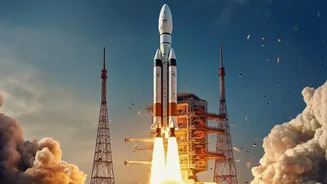
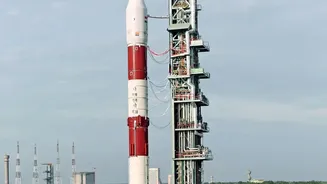
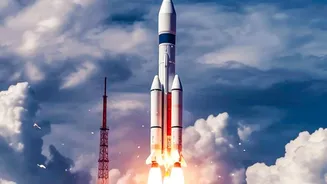
The Gaganyaan programme is arguably ISRO's most ambitious to date: its first mission to send Indian astronauts into space. Following a series of uncrewed test flights, the first of which is slated for late 2026, the first crewed flight is anticipated
in 2027. This historic mission will see a crew of three astronauts launch into a low-Earth orbit for up to a week before returning. Mastering human spaceflight is a monumental technological challenge, requiring a human-rated launch vehicle, advanced life support systems, and flawless recovery operations. Success will make India the fourth nation in the world to independently send its citizens into space, a huge milestone for national prestige and scientific capability.
NISAR: A Watchful Eye on Earth
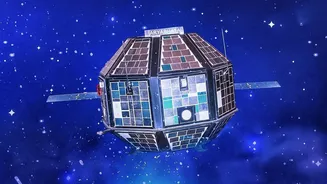
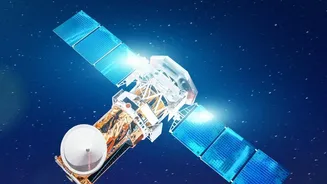
A landmark collaboration between NASA and ISRO, the NISAR (NASA-ISRO Synthetic Aperture Radar) satellite is one of the most expensive Earth-imaging satellites ever built. Launched in July 2025, it is now operational and scanning the globe every 12 days. Using dual-frequency radar, it can see through clouds and darkness to monitor subtle changes in the Earth's surface with centimetre-level precision. This makes it a vital tool for tracking everything from glacial melt and volcanic activity to groundwater levels and deforestation. For India, NISAR provides critical data for disaster management, agriculture, and monitoring climate change impacts.
Shukrayaan-1: A Mission to Venus
After conquering the Moon and Mars, ISRO has its sights set on Venus, often called Earth's "twin" planet. The Venus Orbiter Mission, Shukrayaan-1, is planned for a March 29, 2028 launch. This orbiter will study the dense, toxic atmosphere and volcanic surface of Venus to understand why it evolved so differently from Earth despite its similar size. Understanding the runaway greenhouse effect on Venus could offer valuable insights into climate change on our own planet. The mission represents India's second interplanetary venture and will carry instruments from international partners.
Mangalyaan-2: A Bold Return to Mars
Building on the phenomenal success of its first Mars Orbiter Mission (MOM), ISRO is planning a far more complex follow-up, Mangalyaan-2. Tentatively scheduled for launch after 2026, this mission aims to go beyond just orbiting and will reportedly include a lander, a rover, and even a helicopter. This would make India only the third country to successfully land a spacecraft on the Red Planet. The mission's objective is to study the Martian surface composition, atmosphere, and environment in greater detail, searching for clues about the planet's early history and potential for past life.
LUPEX: Exploring the Moon's Secrets
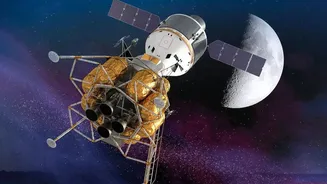
The Lunar Polar Exploration Mission (LUPEX) is a joint venture between ISRO and Japan's space agency, JAXA. Scheduled for no earlier than 2028, the mission will explore the permanently shadowed regions of the Moon's south pole, which are believed to hold vast deposits of water ice. JAXA will provide the rover, while ISRO is developing the lander. The rover will drill into the lunar surface to analyze the quantity and quality of this water ice, a crucial resource that could one day support a permanent human presence on the Moon by providing drinking water, breathable air, and rocket fuel.
SPADEX: Mastering In-Space Docking
The Space Docking Experiment (SPADEX) is a crucial technology-demonstration mission that successfully launched in December 2024. The mission involved two small satellites that demonstrated autonomous rendezvous and docking—the process of two spacecraft meeting and joining together in orbit. This capability is a fundamental building block for future, more complex missions. Mastering docking is essential for building India's planned space station, the Bharatiya Antariksha Station, as well as for conducting satellite servicing, refuelling, and potential sample return missions from other planets.
Bharatiya Antariksha Station: India's Outpost in Orbit
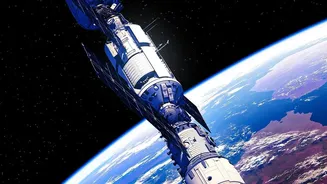
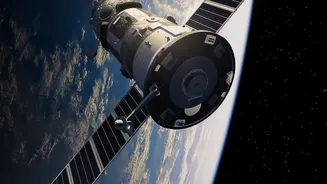
Perhaps the most forward-looking project is the Bharatiya Antariksha Station, India's very own space station. Building on the technologies demonstrated by Gaganyaan and SPADEX, ISRO plans to launch the first module of the station by 2028, with the goal of a fully operational five-module station by 2035. This station will allow Indian astronauts to conduct long-duration scientific experiments in microgravity, test technologies for future deep-space missions, and establish a continuous human presence in space, cementing India's status as a major spacefaring power.