
The Universe's Greatest Enigma
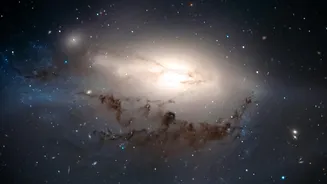
Imagine everything you can see—stars, planets, and galaxies—makes up only 15% of the total matter in the cosmos. The remaining 85% is something scientists call dark matter. It doesn't emit or reflect any light, making it completely invisible to traditional
telescopes. So, how do we know it's there? Its presence is revealed by its gravitational effects on the things we can see. Galaxies spin faster than they should, and clusters of galaxies hold together in ways that would be impossible without this extra, unseen mass acting as a cosmic scaffold. For decades, the exact nature of dark matter has remained one of the most profound mysteries in science. Answering this question is a primary goal of the Nancy Grace Roman Space Telescope, NASA's next-generation observatory launched in August 2026.
Introducing the Roman Space Telescope
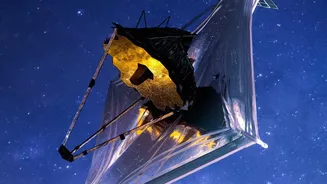
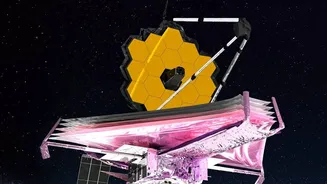
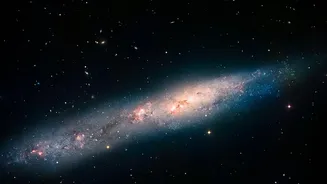
Named after Nancy Grace Roman, NASA's first Chief of Astronomy and the "mother" of the Hubble telescope, this new observatory is designed for cosmic cartography on an unprecedented scale. While its primary mirror is the same size as Hubble's at 2.4 meters, Roman's power lies in its extraordinary field of view. Its Wide-Field Instrument (WFI) can capture a patch of sky at least 100 times larger than Hubble can in a single pointing. This allows Roman to survey huge swathes of the universe with incredible speed and efficiency. Think of it as trading a magnifying glass for a panoramic camera; instead of focusing on one tiny detail, Roman will create a vast, high-resolution atlas of the cosmos, mapping billions of galaxies to trace the hidden architecture of dark matter.
Using Gravity as a Magnifying Glass
Since dark matter is invisible, Roman has to observe it indirectly. Its main technique is a phenomenon predicted by Einstein called gravitational lensing. Anything with mass warps the fabric of spacetime, causing light to bend as it passes by. Roman will look for instances where massive objects in the foreground, like galaxies and unseen clumps of dark matter, act as natural magnifying glasses. This lensing effect distorts the light from more distant galaxies, stretching their images into arcs and smears. By analyzing these tiny distortions across millions of galaxies, a technique known as weak lensing, scientists can create a detailed 3D map showing where dark matter is located and how it is distributed throughout the universe. Roman is expected to identify over 160,000 of these gravitational lenses, giving scientists an enormous new dataset to work with.
More Than Just One Mystery
While mapping dark matter is a core objective, Roman's capabilities make it a versatile tool for cosmic discovery. The same wide-field surveys that map dark matter will also be used to tackle another great cosmic puzzle: dark energy. This mysterious force is causing the expansion of the universe to accelerate. By measuring the distances to millions of galaxies and exploding stars called supernovae, Roman will help chart the history of cosmic expansion with unparalleled precision. In addition, Roman will conduct a massive survey for exoplanets using a technique called gravitational microlensing, with projections suggesting it could discover thousands of new worlds, providing a clearer picture of planetary systems across our galaxy. Its powerful Coronagraph Instrument will also demonstrate new technology for directly imaging Jupiter-sized planets.
A New Era for Cosmic Surveys
The Roman Space Telescope represents a new strategy for astronomy, focused on breadth and volume. While telescopes like Hubble and the James Webb Space Telescope provide deep, narrow views of specific targets, Roman is a survey machine. It will generate an enormous amount of data—an estimated 1.4 terabytes every day—creating the most comprehensive map of the universe ever assembled. This data will not only be used to probe dark matter and dark energy but will also serve a wide range of astrophysical research for years to come. By creating a vast, public atlas of the cosmos, Roman empowers the entire scientific community to make discoveries. After its successful launch in late 2026, the telescope is on its way to its observation point, with the first images expected by early 2027.