







Meet the Precision-Tuning Satellite
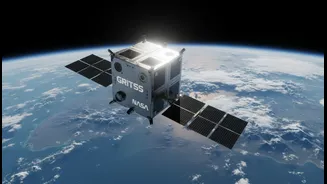
GRITSS, which stands for Geodetic Reference Instrument Transponder for Small Satellites, is a collaborative project between NASA, the University of Massachusetts Lowell, and Dutch satellite manufacturer ISISPACE. Launched successfully on July 7, 2026,
aboard a SpaceX rocket, this compact 12U-XL CubeSat is not designed to take stunning pictures of Earth. Instead, its purpose is far more fundamental. It aims to perfect the very grid we use to measure our planet, known as the International Terrestrial Reference Frame (ITRF). Think of the ITRF as the ultimate global coordinate system, the foundation upon which all modern mapping, navigation, and Earth observation are built. For decades, this frame has been incredibly useful, but it has a tiny, persistent flaw that GRITSS was specifically designed to fix.
The Problem of Three Separate Rulers
To build and maintain the ITRF, scientists rely on combining data from three independent, highly sophisticated measurement techniques. These are the Global Navigation Satellite System (GNSS), which includes the familiar GPS; Very Long Baseline Interferometry (VLBI), which uses radio telescopes to observe distant celestial objects; and Satellite Laser Ranging (SLR), which bounces lasers off satellites to measure distance. While each system is powerful, they don't speak the same language perfectly. When their data is combined, tiny discrepancies known as "site tie" errors emerge. These are millimeter-level inaccuracies that arise from the difficulty of precisely locating the measurement points of the different instruments on the ground. These small errors may seem trivial, but in the world of Earth science, they represent a significant barrier to understanding our planet's most subtle changes.
A Unified Translator in Orbit
GRITSS tackles this problem by acting as a single, unified reference point in space that all three techniques can observe at the same time. It's uniquely equipped to be a universal translator. The satellite carries a specialized GPS receiver and transmitters that capture navigation signals and immediately re-broadcast them in S-band and X-band frequencies that VLBI radio telescopes on the ground can detect. Simultaneously, it is equipped with a laser retroreflector array, a panel of special mirrors that can bounce SLR laser beams directly back to their source. By providing a common target in the sky, GRITSS allows scientists to directly link and cross-calibrate the three disparate systems, effectively eliminating the site tie errors that have long limited global precision.
Sharpening Our View of Earth's Climate
The primary goal of this enhanced accuracy is to help scientists track critical, and often tiny, indicators of climate change. A more precise ITRF is essential for monitoring millimeter-scale changes in global sea levels, the melting of ice sheets in Greenland and Antarctica, and shifts in water resources across continents. These phenomena are central to understanding our planet's response to a warming climate. By improving the baseline accuracy of these measurements, GRITSS will enable more robust climate models and better predictions of future change, directly addressing goals set by the Earth Science Decadal Survey for 1-millimeter reference frame accuracy. This level of precision transforms our ability to diagnose the health of the planet, making it possible to detect subtle but critical trends that were previously lost in the noise of measurement error.
The Future of Navigation and Mapping
While climate science is a major beneficiary, the impact of GRITSS's mission extends across the geospatial world. An ultra-accurate ITRF strengthens the foundation of all positioning and navigation systems. This will lead to more precise topographical maps, a better understanding of continental drift, and more robust performance for next-generation navigation constellations. For a mission housed in a simple CubeSat, GRITSS carries a heavy load of expectations. The engineering to make it work was formidable, requiring thermal controls that keep the satellite's internal temperature stable to within a single degree Celsius to ensure its timing doesn't drift by more than a trillionth of a second. If this technology demonstration proves successful, it will pave the way for a new generation of Earth observation built on a foundation of unprecedented accuracy.