


India's Next Interplanetary Leap
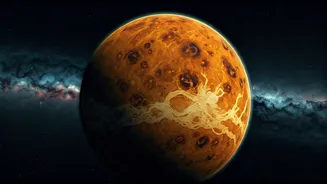
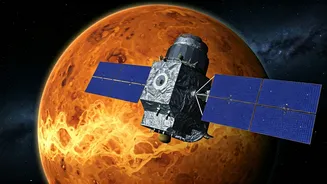
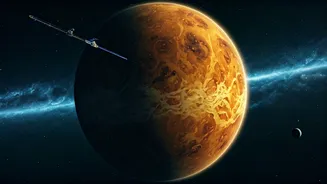
After the resounding success of its missions to the Moon and Mars, the Indian Space Research Organisation (ISRO) has its sights set on the second planet from the sun: Venus. The proposed Venus Orbiter Mission, named Shukrayaan-1, is India's ambitious
first venture to the shrouded planet. Although a final launch date is contingent on government approval, with current timelines pointing towards 2028 or even 2031 to catch an optimal launch window, the mission's objectives are clear. It aims to send a sophisticated orbiter, weighing around 2500 kg, for a multi-year study of Venus's surface and its notoriously dense and toxic atmosphere. This marks a significant step, moving ISRO’s focus into deeper interplanetary science beyond its established successes.
Earth’s Hot, Toxic Twin
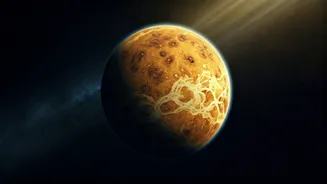
Venus is often called Earth's twin, but it's a fraternal twin that went down a very dark road. While similar in size, density, and composition, Venus is the most hostile planet in the solar system. Its atmosphere is about 90 times denser than Earth's and is composed of 96% carbon dioxide, laced with clouds of sulfuric acid. This composition has created a runaway greenhouse effect, trapping heat and sending surface temperatures soaring to an average of 465°C—hot enough to melt lead. Scientists believe that billions of years ago, Venus may have had a climate similar to Earth's, possibly with liquid water oceans. Understanding what caused this dramatic climate transition is a central mystery that Shukrayaan-1 hopes to unravel.
A Planetary Cautionary Tale
The primary reason for studying Venus is not just planetary curiosity; it's about understanding our own planet's future. The runaway greenhouse effect on Venus serves as an extreme case study for climate change. This phenomenon occurs when a planet’s atmosphere traps so much heat that the temperature keeps rising uncontrollably, creating a positive feedback loop. For instance, as temperatures rise, oceans might start to evaporate, putting more water vapour (a potent greenhouse gas) into the atmosphere, which in turn traps more heat and accelerates the process. By studying the mechanisms that tipped Venus into this irreversible state, scientists can vastly improve our climate models for Earth. It’s a mission to understand a planetary-scale environmental disaster to better safeguard our own world.
The Mission's Toolkit
To peer through the thick, obscuring clouds of Venus, Shukrayaan-1 will be equipped with a suite of cutting-edge instruments developed in India and through international collaborations. The headline instrument is a high-resolution Synthetic Aperture Radar (SAR), which can map the surface in detail regardless of cloud cover or darkness. It will also carry a ground-penetrating radar—a first for a Venus mission—to study the subsurface stratigraphy. Other instruments will analyze the atmospheric chemistry, cloud dynamics, and the interaction between the solar wind and Venus's ionosphere, since the planet lacks a protective magnetic field like Earth's. Some instruments, like the Venus Infrared Atmospheric Gases Linker (VIRAL), are being developed with international partners like Russia and France, highlighting the mission's global scientific importance.
The Search For Answers... and Life?
While studying climate is the core goal, the mission might also touch upon one of science's most exciting questions: are we alone? The 2020 detection of phosphine gas in the upper cloud layers of Venus—a gas that on Earth is produced by microbial life—sparked intense debate and curiosity. While the surface is inhospitable, the upper atmosphere, at an altitude of around 50-60 km, has more Earth-like temperatures and pressure. Shukrayaan-1's atmospheric instruments will be able to gather more data on these chemical signatures, potentially confirming or refuting the presence of gases like phosphine and helping to determine their origin. While the chances may be slim, the mission provides an opportunity to investigate one of the most intriguing, albeit unlikely, potential habitats for life in our solar system.