




A Sugar Between the Stars
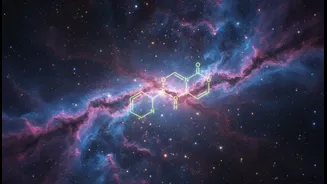
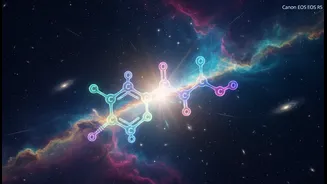
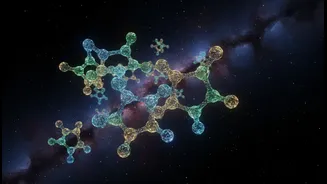
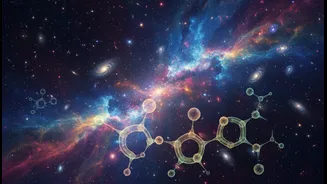
In a remarkable discovery, astronomers have identified erythrulose, a four-carbon sugar, floating in a molecular cloud near the center of our Milky Way galaxy. This isn't just any molecule; it's the first time a true sugar has been directly detected in the interstellar
medium—the diffuse material that exists in the space between star systems. While simpler sugar-related molecules like glycolaldehyde have been found before, erythrulose is a more complex and significant find. Found here on Earth in raspberries and used in some sunless tanning lotions, its presence in space is a game-changer for astrochemistry. The detection was made by an international team using highly sensitive radio telescopes in Spain, which picked up the faint radio signals, or spectral fingerprint, emitted by erythrulose molecules some 26,745 light-years away.
The Cosmic Chemical Factory
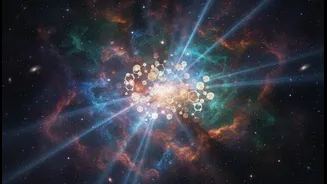
The discovery was made in a region known as G+0.693-0.027, a dense and chemically rich molecular cloud. These clouds are often called 'stellar nurseries' because they are where new stars and planets are born. Finding erythrulose here suggests that the basic ingredients for life might be present even before planets form. Scientists have long theorized that the building blocks of life didn't necessarily originate on Earth but could have been delivered by comets and meteorites. Discoveries of sugars like ribose in meteorites had already pointed to this possibility, but finding a sugar floating freely in a stellar nursery provides a missing link in this chain of evidence. The team found that erythrulose was surprisingly abundant, at least eight times more so than simpler three-carbon sugars, which weren't detected at all. This challenges the idea that complex molecules always form one carbon atom at a time.
Prebiotic Chemistry's Sweet Spot
So, why is a sugar molecule so important? Sugars, or carbohydrates, are fundamental to life as we know it. They are a source of energy and, crucially, form the structural backbone of RNA and DNA, the molecules that carry genetic information. Erythrulose is considered a 'prebiotic' molecule—a chemical precursor to life. Its detection supports the 'RNA World' hypothesis, which suggests that RNA, not DNA, was the original genetic material for the first life forms. Scientists believe that erythrulose, on a primitive world, could easily transform into other sugars needed to build ribonucleotides, the building blocks of RNA. The fact that this sugar can form in the extreme cold of space (around -250°C) on the surface of icy dust grains shows that the universe is capable of complex organic synthesis under very harsh conditions.
From Stardust to Life's Ingredients
This discovery does not mean we've found alien life. What it does mean is that the raw materials for life are far more widespread than previously confirmed. Scientists estimate that millions of tonnes of erythrulose could have rained down on early Earth during a period of intense cometary bombardment. This cosmic delivery service could have supplied the planet with a ready-made stock of essential sugars, kick-starting the prebiotic chemical reactions in Earth's primordial soup that eventually led to life. According to Dr. Izaskun Jiménez-Serra, who led the research, this finding opens up the exciting possibility of discovering other, even more complex sugars like ribose in space, bringing us one step closer to understanding our own origins. The detection of erythrulose, a chiral molecule (meaning it has a 'handedness' like our hands), is also a key step, as life on Earth exclusively uses one 'hand' of sugars and amino acids.