



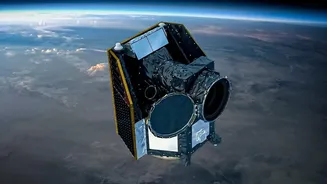

A Junkyard Above Our Heads
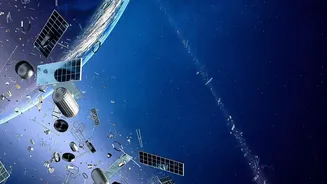
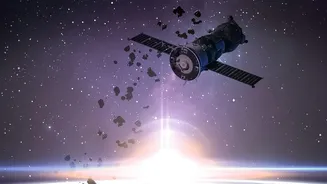
Imagine a celestial junkyard orbiting Earth at speeds of over 28,000 kilometres per hour. This isn't science fiction; it's the reality of Low Earth Orbit (LEO). Decades of space activity have left behind a dangerous legacy: defunct satellites, spent rocket
stages, and millions of smaller fragments from collisions and explosions. The U.S. Space Surveillance Network tracks tens of thousands of objects larger than a softball, but there are hundreds of thousands more that are too small to monitor yet large enough to cause catastrophic damage to an operational satellite or even the International Space Station. This growing cloud of debris presents a critical risk, threatening the satellite infrastructure that powers our daily lives—from GPS navigation and financial transactions to weather forecasting. The fear is a scenario known as the Kessler Syndrome, a cascading chain reaction of collisions where each impact creates more debris, exponentially increasing the risk until entire orbits become unusable.
The Rise of the Space Janitor
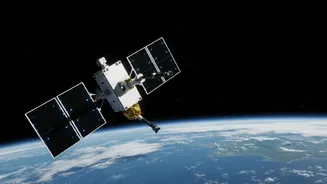
For years, the solution to space debris was mitigation—designing satellites to deorbit themselves at the end of their life. But this doesn't address the junk already up there. Now, a new commercial industry is emerging: active debris removal. One of the leading companies in this field is Astroscale, a firm with operations in Japan and the U.K. that is developing innovative solutions for on-orbit servicing. Their approach is proactive, offering an 'end-of-life' service for satellite operators. The company's flagship program, ELSA (End-of-Life Services by Astroscale), is designed to demonstrate the technologies needed to safely rendezvous with, capture, and deorbit defunct satellites. Their upcoming ELSA-M mission, planned for a 2026 launch, will be the first commercial attempt to remove a full-sized, unresponsive satellite from orbit, marking a significant step towards a sustainable space environment.
How Magnetic Capture Works
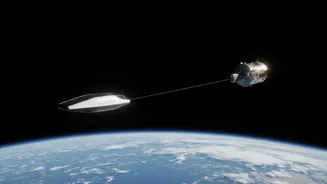
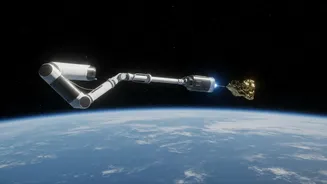
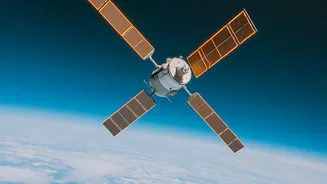
The headline technology in Astroscale's arsenal is a sophisticated magnetic capture system. While concepts like nets and harpoons are also being explored, the magnetic approach offers a gentle and reliable way to dock with a target. The system relies on a servicer spacecraft that approaches the target debris. For this to work, future satellites need to be manufactured with a standardized ferromagnetic 'docking plate'. Once in close proximity, the servicer extends its capture mechanism, which uses a powerful magnet to securely attach to the docking plate. This creates a firm connection without the complexity and risk of a high-speed grappling manoeuvre. After a successful capture, the servicer spacecraft uses its own thrusters to drag the defunct satellite into a lower orbit. From there, it releases the junk into a trajectory that ensures it will burn up safely upon re-entry into Earth's atmosphere, leaving the orbital highway a little cleaner.
From Demonstration to Operation
Astroscale has already proven its core technology in space. The ELSA-d mission, launched in 2021, successfully performed repeated tests where a 'servicer' spacecraft released and then magnetically recaptured a smaller 'client' satellite multiple times. These demonstrations validated the autonomous guidance systems and the magnetic capture mechanism itself, proving it could work in a real-world orbital environment. The upcoming ELSA-M mission is the next evolution, graduating from a demonstration with a prepared target to a full-scale commercial service. Scheduled for launch in 2026, the 520 kg ELSA-M servicer will rendezvous with and deorbit an inactive OneWeb satellite. This mission, supported by the UK and European Space Agencies, is designed to prove not just the technology but the business case for orbital cleanup, setting a precedent for responsible satellite fleet management.