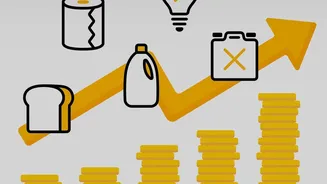







Ever feel like your money doesn't stretch as far as it used to? You're not just imagining it. It's the effect of inflation, a silent process that constantly redefines what your hard-earned rupees can actually buy. Let's break down how it works.
What Exactly is Inflation?
In simple
terms, inflation is the rate at which the general level of prices for goods and services is rising, and subsequently, purchasing power is falling. Think of it like a slow leak in your wallet's value. The amount of money you have—say, a ₹500 note—doesn't change, but what you can exchange it for does. If a packet of milk cost ₹50 last year and costs ₹53 this year, that 6% increase is inflation in action. Your ₹500 note now buys fewer packets of milk. Over time, these small changes compound, having a significant impact on your household budget and long-term financial goals.
The ₹1000 Bill: A Tale of Two Decades
To make this real, let's compare what a ₹1000 note could get you in 2016 versus today. A decade ago, that note might have comfortably covered a full tank of petrol for a small car, a week's worth of milk, and a trip to the cinema with snacks. Today, that same ₹1000 struggles to cover just one of those expenses adequately. For instance, a domestic LPG cylinder that cost around ₹420 in Delhi in 2016 now costs over ₹900. A meal for two at a decent restaurant that might have been ₹500-700 is now easily ₹1000-1500 or more. This erosion of value is the most direct way we all experience inflation. Your money is still there; its ability to command goods and services has simply diminished.
How is This Measured in India?
The most common measure of inflation in India is the Consumer Price Index, or CPI. The Ministry of Statistics and Programme Implementation (MoSPI) calculates this by tracking the prices of a fixed basket of goods and services that an average household consumes. This basket includes everything from food and beverages to housing, clothing, transport, and healthcare. When the total price of this basket goes up, the CPI rises, and we report that as inflation. For October 2026, India's headline inflation rate stood at 6.09%, indicating that on average, prices were about 6% higher than in October of the previous year.
Beyond Groceries: The Ripple Effect
The impact of inflation isn't confined to your grocery or fuel bills. It has a cascading effect across the entire economy. A rise in fuel prices, for example, increases transportation costs for farmers, manufacturers, and distributors. This, in turn, drives up the final price of everything from vegetables to electronics. More importantly, it impacts long-term financial goals. The cost of education is known to rise faster than general inflation, often at 10-12% annually. This means a degree that costs ₹10 lakh today could cost ₹20 lakh in just six or seven years. Similarly, the amount you think you need for retirement can be drastically underestimated if you don't account for decades of rising living costs.
Protecting Your Money's Value
So, what can you do? The key is to ensure your money is growing at a rate that is at least equal to, and ideally faster than, the rate of inflation. Leaving large sums of cash in a low-interest savings account is often a losing battle. If your bank offers 4% interest but inflation is running at 6%, the 'real return' on your savings is actually negative 2%. This is why financial advisors emphasize investing. While all investments carry risks, instruments like mutual funds, stocks, and even certain government bonds are designed to generate returns that can outpace inflation over the long term, helping to preserve and grow your purchasing power.