





The One Blueprint, Many Buildings Problem
Think of your genome as a single, enormous cookbook. Every cell in your body, from a neuron in your brain to a muscle cell in your heart, gets an identical copy of this book. Yet, a neuron doesn't try to contract like a heart cell, and a heart cell doesn't transmit
nerve signals. This is because each cell type reads only specific recipes, or genes, relevant to its job. The core mystery of biology lies in understanding the complex rules that tell each cell which chapters of the cookbook to read and which to ignore. These rules are why different cells, despite having the same DNA, can respond in vastly different ways to the same genetic instructions or mutations.
Enter AlphaGenome 2: An AI Decoder Ring
Following its work on models like Enformer and AlphaMissense, DeepMind's new research model, AlphaGenome 2, acts as a sophisticated decoder for these cellular rules. It’s an AI system designed to predict how gene activity changes from one cell type to another. While older models could predict the effects of DNA variants on tissues as a whole, their signals could be diluted. AlphaGenome 2 is trained on data from over 100 million individual cell profiles, allowing it to predict how a specific DNA change will play out not just in the liver, for example, but in a specific type of liver cell. It can even predict how a cell's response might change if it's in a diseased or activated state, such as an immune cell responding to a vaccine.
The Importance of 'Junk' DNA
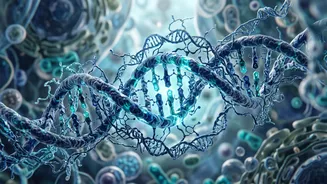
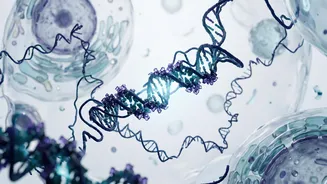
The key to this cellular diversity lies in the 99% of our DNA that does not code for proteins. Once dismissed as 'junk DNA', this non-coding portion is now understood to be a vast and complex control panel. It contains regulatory elements like 'enhancers' and 'silencers', which act like switches and dimmers, turning the activity of genes up or down. A single gene might be influenced by multiple enhancers, some located very far away on the DNA strand. The combination of which switches are flipped in a particular cell is what defines its identity and function. A DNA variant in one of these non-coding regions can disrupt this regulation, leading to disease.
Seeing the Switches in Every Cell
AlphaGenome 2's advancement is its ability to model these long-range interactions across vast stretches of DNA—around 200,000 base pairs—and connect them to specific cell states. By taking a cell's biological context as an input, the model can learn how the same DNA sequence is interpreted differently across cell types. This helps scientists pinpoint which non-coding variants are relevant to which cells. For instance, a variant might have no effect in a skin cell but be catastrophic in a specific neuron, explaining the cellular basis of some neurological disorders. By identifying nearly twice as many gene-expression-linked variants as previous models, it provides a much higher-resolution map of our genetic wiring.
From Prediction to Personalized Medicine
The practical implications are enormous. Understanding how genetic variants function at a cellular level is a critical step toward precision medicine. For example, it could help researchers understand why a cancer drug works for one person but not another, or identify the specific cell types where a disease like Alzheimer's originates. By predicting the impact of the 9 billion possible single-letter changes in the human genome, AI tools like this give researchers a powerful way to prioritize which variants to study in the lab. This accelerates the journey from identifying a disease-associated gene to understanding its mechanism and, ultimately, developing a targeted therapy.