






Verify the Assessment Year (AY)
One of the most common mistakes is selecting the wrong Assessment Year. For instance, for income earned in the financial year 2025-26, the correct Assessment Year is 2026-27. An error here means the tax you paid won't be reflected for the correct period,
potentially leading to a tax demand notice. The good news is that this can now be corrected online via the e-filing portal. However, you must act fast. The correction window for the Assessment Year is only seven days from the date you deposited the challan. To make the change, you need to log in to the income tax portal, navigate to 'Services' > 'Challan Correction', and raise a request.
Check Major and Minor Tax Heads
Taxes are categorised under different 'Heads'. The Major Head identifies the type of tax (e.g., 0021 for 'Income-tax other than companies'), while the Minor Head specifies the nature of payment. Common Minor Heads include 100 for Advance Tax, 300 for Self-Assessment Tax, and 400 for Tax on Regular Assessment. Paying tax under the wrong head is a frequent error. For example, paying your final tax liability under 'Advance Tax' instead of 'Self-Assessment Tax' can cause a mismatch. The e-filing portal allows corrections to both Major and Minor heads within 30 days of the challan deposit date. This online facility is available for challans from AY 2020-21 onwards.
The Online Correction Process
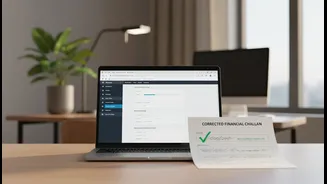
The Income Tax Department has simplified the correction process, moving it online for most common errors. To initiate a correction, log in to the e-filing portal with your PAN. Go to the 'Services' tab and select 'Challan Correction'. From there, you can 'Create Challan Correction Request'. The portal will display unconsumed challans that are eligible for correction. You can select the challan and the attribute you wish to change—be it the AY, Major Head, or Minor Head. After making the changes, you must e-verify the request using methods like Aadhaar OTP or a Digital Signature Certificate (DSC). The status of your request can be tracked on the portal, and it typically takes 7-20 days for the changes to be updated.
What You Can't Correct Online
While the online system is convenient, it has its limits. Crucially, you cannot correct the PAN number on a paid challan online. If you've paid tax using the wrong PAN, the process is more complex and requires contacting your bank or the Assessing Officer. Similarly, if you miss the specific correction windows—7 days for AY and 30 days for tax heads—the online option is no longer available. The online correction service is also limited to challans for AY 2020-21 and onwards and for specific minor heads (100, 300, 400). For older challans or other types of payments, you will have to follow the offline procedure. Also, a challan can only be corrected online once through the portal; further changes require approaching your Assessing Officer.
When to Approach Your Bank or AO
For errors that cannot be fixed online, you must resort to the offline method. This involves approaching either the bank where you deposited the challan or your Jurisdictional Assessing Officer (AO). For a PAN correction on a physical challan, you may be able to approach the bank within seven days. For other issues, or after the online time limit has passed, you must submit a written application to your AO. This request should detail the error and the required correction, and you must attach supporting documents like a copy of the original challan and proof of identity. You can find your AO's details on the income tax portal under the 'Know Your AO' service.
Before You File: Final Checks
Before submitting your Income Tax Return, always cross-verify your tax payments. Log in to the e-filing portal and check your Form 26AS and Annual Information Statement (AIS). These documents consolidate all the tax paid by you or on your behalf. Ensure that all your challan payments are correctly reflected there with the right AY and amounts. If you find a discrepancy, it’s a sign that a challan may have an error. Never file an ITR with incorrect challan details hoping it will be sorted out later. Correcting the challan first ensures a smooth processing of your return and prevents potential notices and demands from the tax department.