


A Star's Ghostly Afterlife
To understand this discovery, we first need to talk about white dwarfs. When a star like our Sun runs out of nuclear fuel, it doesn't explode in a supernova. Instead, it swells into a massive red giant, often swallowing its inner planets, before shedding
its outer layers. What's left behind is a tiny, incredibly dense, and hot core called a white dwarf. It's essentially the ghost of a star, about the size of Earth but with the mass of the Sun, that will slowly cool and fade over billions of years. For a long time, these stellar graveyards were considered quiet places. Any planets that survived the red giant phase would be pushed into distant, cold orbits. But astronomers started noticing something odd: many white dwarfs had 'polluted' atmospheres, containing heavy elements like iron and magnesium that should have sunk into the star's core. This suggested the white dwarfs were actively feeding on something—most likely the debris of shattered asteroids or planets that had been torn apart by their intense gravity.
From Dust to a New World
This is where the idea of a 'second-generation' planet comes in. While first-generation planets (like Earth) form from the disc of gas and dust that gives birth to a star, a second-generation planet is one that forms much later, from the debris disc created after the star dies. This disc is a chaotic swirl of pulverised asteroids and the remains of older worlds. Scientists have theorised for decades that, under the right conditions, this material could clump together, first into smaller bodies called planetesimals, and eventually into a fully-fledged planet. Finding proof, however, has been difficult. This new discovery provides some of the most compelling evidence to date that this process of cosmic recycling is not just possible, but is actively happening.
The Clues in the Starlight
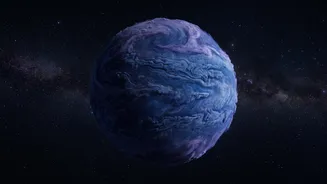
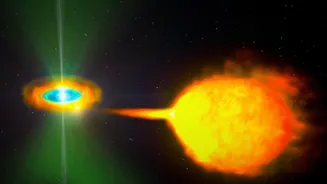
The latest evidence comes from a white dwarf known as HS 0209+0832, located about 270 light-years away. By re-analysing 25-year-old data from the Hubble Space Telescope, a team of astronomers made a startling find. The atmosphere of this white dwarf contained an unusually high amount of an element called niobium, over 1,000 times more than is found in our Sun. Niobium is special because it's an element forged only in the exotic, fiery conditions inside a dying star. Its presence strongly suggests that the white dwarf is accreting, or pulling in, material that was created during its own death throes—material that has since coalesced into a planetary body. This body, potentially a gas giant, is thought to be orbiting the dead star every 4.4 days, and the white dwarf's intense heat is stripping material from its surface, creating the chemical signature observed by Hubble.
A Glimpse into Our Own Future
This discovery is more than just an astronomical curiosity; it's a preview of our own solar system's distant future. In about five billion years, our Sun will also become a white dwarf. It will first expand into a red giant, destroying Mercury, Venus, and possibly Earth. The outer planets and the asteroid belt will likely survive, but their orbits could be thrown into chaos. Eventually, the wreckage of our solar system could form a debris disc around the Sun's dead core. The findings around HS 0209+0832 suggest that from this debris, a new generation of planets could one day form in our own cosmic backyard, long after Earth is gone. It reveals that planetary systems are not static but can be reborn, with death giving way to new creation in the most unexpected of places.