




Rahul Dravid: The Great Wall
Any discussion about India's greatest No. 3 begins and often ends with Rahul Dravid. Aptly nicknamed 'The Wall', Dravid was the epitome of resilience, technique, and concentration. For over a decade, he was the bulwark of the Indian batting line-up, frustrating
the best bowling attacks in the world. An incredible 10,501 of his 13,265 career Test runs were scored from the one-down position. He amassed a staggering 28 centuries while batting at number three, the most by any Indian. His ability to bat for long periods was legendary, exemplified by his epic 270 against Pakistan in Rawalpindi and his crucial 233 against Australia in Adelaide, which secured a famous series victory. Dravid didn't just score runs; he defined an era of Test match batting, and his success at No. 3 coincided with India's emergence as a formidable force in overseas Tests.
Cheteshwar Pujara: The Modern Monk
The heir to Rahul Dravid's throne, Cheteshwar Pujara, carried the torch of the traditional Test batter into the modern, fast-paced era. A player of immense patience and grit, Pujara became India's reliable man for a crisis. He is the second-highest run-scorer for India at the No. 3 position, with 18 of his 19 career Test centuries coming from that spot. His defining moment came during the historic 2018-19 tour of Australia, where he ground down the fearsome Aussie attack, facing a record 1,258 balls in the four-match series and scoring 521 runs to lead India to its first-ever series win Down Under. His innings of 202 against Australia in Ranchi in 2017, where he faced 525 balls, is the most by any Indian in a Test innings, a testament to his powers of concentration.
Mohinder Amarnath: The Comeback King
One of the gutsiest cricketers to have played for India, Mohinder 'Jimmy' Amarnath was a pillar of strength in the middle order during the 1970s and 80s. Known for his courage against fiery fast bowlers, Amarnath made the No. 3 position his own. He scored 2,907 of his Test runs at one-down, including eight centuries at an average of 47.65. His finest hour came in the 1982-83 season when he dominated the mighty West Indian and Pakistani pace attacks in their own backyards, scoring heavily and establishing himself as one of the world's best. Nine of his 11 career Test centuries were scored overseas, underlining his solid technique and unflappable temperament in challenging conditions.
The Colonel and The Artist
Before the era of Dravid and Pujara, the No. 3 spot was graced by legends like Dilip Vengsarkar and Gundappa Viswanath. Vengsarkar, known as 'The Colonel', was a prolific scorer, particularly at Lord's, where he scored three Test centuries. Viswanath, the wristy artist from Karnataka, was a key part of India's batting through the 1970s. His debut century against Australia in 1969 set the tone for a magnificent career. While VVS Laxman is famously remembered for his heroic 281 against Australia in 2001, that knock came at No. 3, marking the highest individual score for an Indian at that position. Vinod Kambli also had a prolific, albeit brief, run, scoring four centuries from the No. 3 spot.
The New Generation
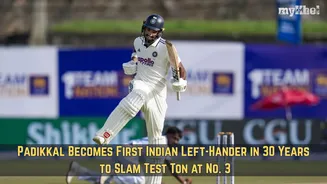
In recent times, the No. 3 position has seen a period of transition since Pujara's departure. Shubman Gill held the spot for a time, scoring a century against Bangladesh in September 2024. After a spell of 19 Tests without a century from that position, Devdutt Padikkal broke the drought with a magnificent unbeaten 131 against Sri Lanka in Galle on August 15, 2026. This innings made him only the second left-handed Indian to score a Test hundred from No. 3 this century, after Sourav Ganguly. As India continues to build its Test side, finding a long-term successor to these legends remains a key priority.