





A Signal From the Void
For years, astronomers have been captivated by Fast Radio Bursts, or FRBs. These are unimaginably powerful flashes of radio waves from distant galaxies that last for mere milliseconds. In that fleeting moment, they can release as much energy as the Sun
does in three days. Most FRBs are a one-time event, appearing and then vanishing forever, which makes them incredibly difficult to study. But recently, using powerful new radio telescopes, scientists have started to find rare 'repeaters'—sources that flash more than once. The latest discovery, however, is something else entirely. Astronomers have detected an FRB that doesn't just repeat, but does so on a strict, predictable schedule.
What is This Cosmic Clockwork?
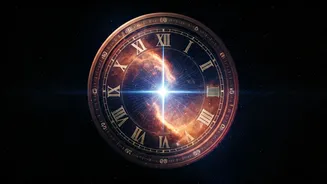
This newfound object sends out a cluster of bursts over a few days, then goes quiet for a set period, before starting the cycle all over again. This clockwork-like periodicity is a game-changer. The first such periodically active FRB, known as FRB 180916, was found to have a 16.35-day cycle, with bursts occurring in a four-day window followed by 12 days of silence. This regularity offers a tantalizing clue about its origin. A one-off blast could be from a cataclysmic event like a star exploding. But a repeating, scheduled signal suggests an object or a system of objects that is stable and orbiting, rotating, or precessing (wobbling) in a predictable way.
The Usual (and Unusual) Suspects
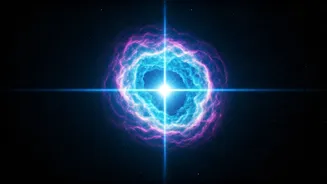
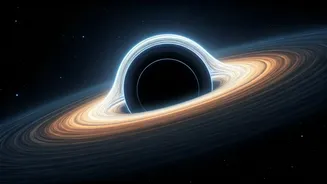
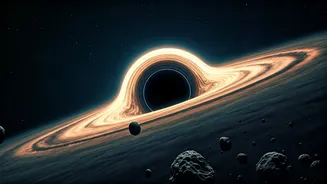
So, what could be the engine behind this cosmic alarm? The leading suspect is a magnetar, a type of super-dense neutron star with a magnetic field thousands of trillions of times stronger than Earth's. These are the most powerful magnets in the universe. One theory is that a magnetar is orbiting another object, perhaps a black hole or another star. The signal might only be visible to us when the magnetar is at a certain point in its orbit, creating the 'on' phase of the alarm clock. Another idea is that the magnetar itself is wobbling like a spinning top, a process called precession. Its radio beam would then sweep across our line of sight at regular intervals, much like the beam from a lighthouse. This steady beat is what has the scientific community so excited, as it helps narrow down the range of exotic possibilities.
Why This Discovery Matters
Finding a periodic FRB is more than just solving a cosmic whodunit. These signals travel across billions of light-years to reach us, and on their journey, they pass through galaxies, gas clouds, and the vast, empty spaces in between. By studying how the radio waves are altered on their journey, scientists can use FRBs as a unique tool to probe the structure of the universe. The repeating nature of this 'alarm clock' allows for planned observations, giving researchers the chance to study the source and the space between us and it in unprecedented detail. It's like having a deep-space flashlight that turns on at a predictable time, illuminating the cosmic web of matter that was previously invisible and helping us understand some of the biggest mysteries in astronomy.