


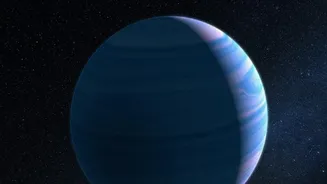
The Solar System's Tilted Giant
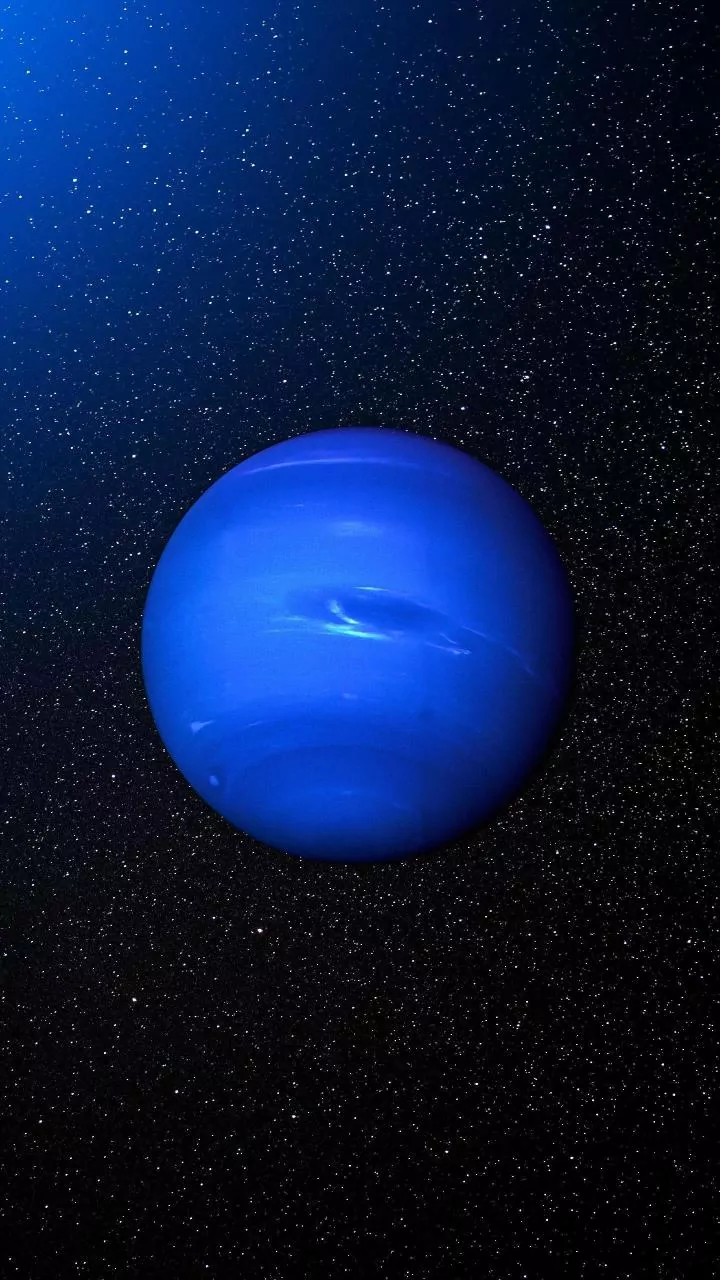
To understand why the moons of Uranus are so fascinating, you first have to appreciate the planet itself. Unlike every other planet, which spins more or less upright, Uranus is tilted on its side by a staggering 98 degrees. This means it essentially rolls
around the Sun, causing extreme seasons where its poles are plunged into 42 years of continuous darkness, followed by 42 years of constant sunlight. This bizarre orientation is believed to be the result of a cataclysmic collision with an Earth-sized object early in its history. That same impact likely had a profound effect on how its moons formed and evolved, setting the stage for the strange system we see today. All of its regular moons orbit along this severe tilt, making their orbital plane nearly perpendicular to that of the other planets.
A System of Regular and Irregular Moons
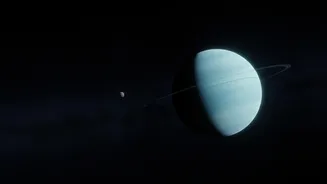
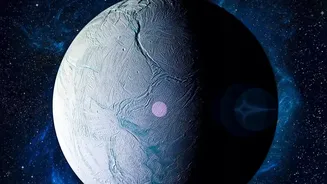
Uranus has 29 known moons, which are divided into three main groups: inner moons, five major moons, and irregular moons. The inner and major moons are considered 'regular' because they have nearly circular, prograde orbits that lie in the same plane as the planet's equator. The five major moons—Miranda, Ariel, Umbriel, Titania, and Oberon—are large enough to have been shaped by their own gravity. In stark contrast, the irregular moons are a motley crew. These are typically smaller bodies with distant, highly tilted, and often retrograde (backward) orbits. Scientists believe these are not homegrown moons but captured asteroids and other objects that strayed too close to Uranus's gravity. This mix of native and captured moons creates a complex and sometimes chaotic gravitational dance.
Chaotic Orbits and Dusty Clues
Recent research has highlighted just how dynamic this system is. While there isn't one single 'new' orbit causing a stir, ongoing studies reveal a system in constant flux. For instance, observations have shown that the orbits of the inner moons have changed significantly in just a decade. Some of the innermost moons, like Cordelia and Ophelia, act as 'shepherd moons,' using their gravity to keep Uranus's faint rings in line. Furthermore, scientists were surprised by recent findings about the colour of the major moons Titania and Oberon. They expected the moons' trailing hemispheres to be darkened by radiation from Uranus's magnetosphere. Instead, they found the opposite: the leading hemispheres were darker and redder. The prevailing theory is that dust knocked off the irregular outer moons by micrometeorite impacts is spiralling inward and coating the forward-facing sides of Titania and Oberon, like bugs on a windshield. This suggests a constant exchange of material between the different families of moons.
Discovering New Pieces of the Puzzle
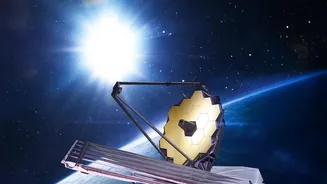
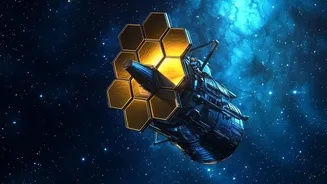
The powerful James Webb Space Telescope (JWST) has been instrumental in uncovering new details. In 2025, astronomers using JWST announced the discovery of Uranus's 29th moon, temporarily designated S/2025 U1. At just about 10 kilometres in diameter, it's one of the smallest moons found there and was missed by the Voyager 2 spacecraft during its 1986 flyby. The moon has a nearly circular path, suggesting it formed where it is now, nestled among the planet's other inner moons and faint rings. Finding such a small, faint moon highlights that many more could be waiting to be discovered, each holding potential clues. The complex interactions between these tiny moons and the planet's rings suggest a chaotic history that blurs the line between a moon system and a ring system.