

The 'Goldilocks' Misconception
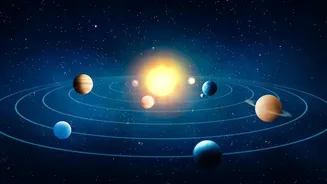
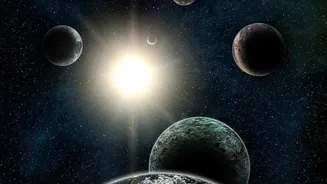
First, let's break down what the 'habitable zone' actually means. Coined by astrophysicists, it refers to the orbital range around a star where a planet could theoretically possess liquid water on its surface. It’s not too hot that water boils away, and
not so cold that it freezes solid—it’s 'just right'. This is a crucial starting point because, as far as we know, liquid water is a fundamental ingredient for life. However, scientists stress that this is a simplified model. It's a tool to help prioritize which of the thousands of exoplanets are worth a closer look with powerful telescopes, not a guarantee of habitability. The gap between a planet that could have liquid water and one that actually hosts life is enormous.
An Atmosphere of Uncertainty
A planet’s address in the habitable zone is meaningless without the right kind of atmosphere. An atmosphere does more than just provide air to breathe; it creates the necessary pressure to keep water in a liquid state and acts like a planetary blanket, trapping heat through the greenhouse effect. Without it, a perfectly positioned planet would be a barren, airless rock. Venus, for example, is near the inner edge of our sun's habitable zone but has a runaway greenhouse effect, making its surface hot enough to melt lead. Conversely, a planet without a thick enough atmosphere can't retain heat, becoming a frozen desert like Mars. The presence, composition, and thickness of an atmosphere are all critical factors that determine a planet's true climate.
The Star of the Show
Not all stars are as stable and life-friendly as our sun. A significant portion of stars in the Milky Way are red dwarfs. While they are incredibly common, they present unique challenges. Their habitable zones are much closer to the star, which often leads to planets becoming 'tidally locked'. This means one side of the planet permanently faces the star in perpetual daylight, while the other side is locked in eternal night, creating extreme temperature differences. Furthermore, many of these red dwarf stars, especially when young, are incredibly volatile, blasting their nearby planets with intense stellar flares and radiation that could strip away atmospheres and sterilize surfaces.
A Planet's Inner Strength
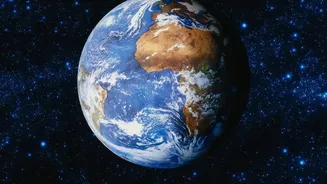
A truly Earth-like world needs more than just a pleasant surface temperature; it needs the right stuff on the inside. A planet must have enough mass to gravitationally hold onto its atmosphere. But just as important is what's at its core. Earth's molten iron core generates a powerful magnetic field, a crucial shield that deflects harmful solar winds and cosmic radiation that would otherwise erode our atmosphere. Mars, for instance, is thought to have lost its magnetic field billions of years ago, which contributed to its atmosphere thinning and its water disappearing. Active geology, like plate tectonics and volcanism, also plays a vital role by cycling nutrients and regulating the climate over geological timescales, processes we are only beginning to understand in an exoplanetary context.