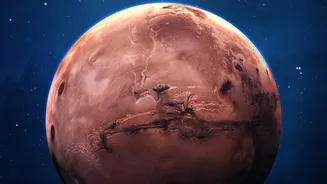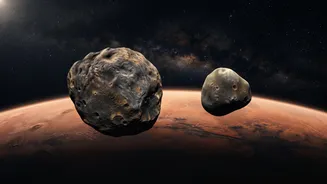



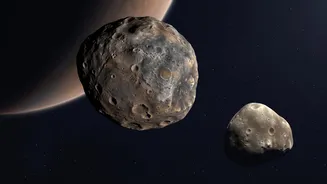
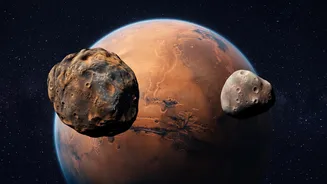
Mars has two tiny, lumpy moons named Phobos and Deimos, and for over a century, scientists have been stumped by a simple question: where did they come from? This cosmic detective story is now heating up, with new theories and a daring mission.
A Tale of Two Odd Moons
Unlike Earth’s
large, spherical Moon, the moons of Mars are cosmic oddities. Phobos and Deimos are small, potato-shaped, and look more like asteroids than traditional moons. Phobos, the larger of the two, is a mere 22 kilometres across, while Deimos is even smaller at about 12 kilometres. They both orbit very close to Mars. In fact, Phobos is so close that it circles the planet three times a day and is slowly being pulled inward, destined to crash into Mars or be torn apart to form a ring in about 50 million years. This strange nature has left scientists with a puzzle that has two main, conflicting solutions.
Theory 1: The Asteroid Heist
For a long time, the leading hypothesis was that Phobos and Deimos are captured asteroids. This idea makes sense at first glance. Their dark, lumpy surfaces strongly resemble the carbon-rich asteroids found in the asteroid belt between Mars and Jupiter. Proponents of this theory suggest that these two bodies were wandering through the solar system, strayed too close to Mars, and were snared by its gravitational pull. It’s a straightforward explanation for why they look so different from Mars itself. However, there’s a major flaw in this otherwise neat story.
The Problem with Capture
The orbits of Phobos and Deimos are the biggest argument against the capture theory. Both moons circle Mars in very neat, nearly circular paths that lie almost perfectly above the planet's equator. When a planet captures a passing asteroid, the resulting orbit is usually eccentric and tilted. Getting two asteroids to settle into such orderly, aligned orbits is incredibly unlikely from a physics standpoint. This orbital perfection strongly suggests the moons didn't come from somewhere else but were instead born right where they are.
Theory 2: The Giant Impact
This leads to the second major theory: a giant impact. Much like how Earth’s Moon is thought to have formed, this hypothesis proposes that a massive object—perhaps the size of a dwarf planet—slammed into a young Mars billions of years ago. The colossal collision would have blasted a huge cloud of vaporized rock and debris from the Martian crust into orbit. This material would have then formed a ring around the planet, which eventually clumped together to form Phobos and Deimos. This scenario elegantly explains their stable, equatorial orbits. Some models even suggest the impact initially formed a larger, inner moon that later crashed back into Mars, leaving only the two smaller survivors behind.
A Daring Mission for Answers
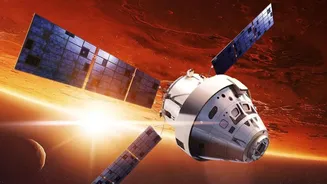
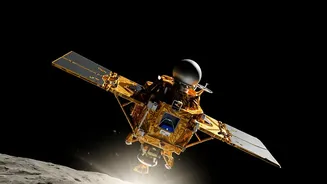
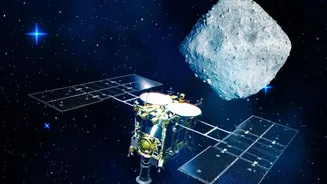
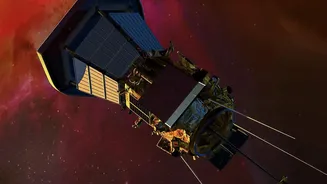
For decades, scientists have been locked in this debate, but the deadlock may soon be broken. Japan's Aerospace Exploration Agency (JAXA), with support from NASA and other international partners, launched the Martian Moons eXploration (MMX) mission in October 2026. This ambitious probe is on its way to the Red Planet, with an expected arrival in 2027. Its primary goal is to do something unprecedented: land on Phobos, collect at least 10 grams of surface material, and return it to Earth for analysis in 2031. By studying an actual sample in labs, scientists will be able to determine its composition with incredible precision. If the material is rich in organics and resembles primitive asteroids, it would support the capture theory. If it’s made of Martian rock, that would be strong evidence for the giant impact hypothesis. The mission will also perform flybys of Deimos, giving us our best look yet at the smaller moon.