







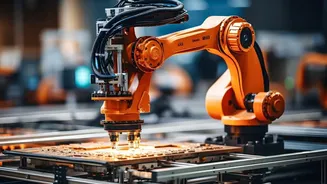

The Demographic Dilemma
For decades, a growing workforce fuelled Asia's economic miracle, lifting millions out of poverty and creating global manufacturing powerhouses. That engine is now sputtering. In advanced economies across East Asia, populations are ageing at a pace faster
than anything seen in Europe or North America. According to a recent IMF report presented at the IMF-World Bank Annual Meetings, nations like Japan, South Korea, and China are projected to lose nearly a quarter of their working-age population by 2050. This isn't a distant problem; it's a present-day reality creating significant labour shortages and threatening to put the brakes on economic growth. Some countries, like Thailand, face the daunting prospect of getting old before they get rich, putting immense pressure on public budgets for pensions and healthcare.
AI as a Productivity Engine
Faced with a shrinking pool of workers, the IMF's analysis pivots to a technological solution: boosting the productivity of the remaining workforce. This is where artificial intelligence enters the picture. During a recent presentation, IMF Managing Director Kristalina Georgieva explained that productivity gains from widespread AI adoption could largely offset the economic drag from these demographic shifts. For advanced Asian economies, the IMF projects that AI could lift annual growth by 0.5 to 1 percentage point. If these gains are fully realised, Georgieva noted, these countries can 'more than offset the demographic pressure'. The idea is not just to replace missing workers with robots, but to use AI to augment human capabilities, enhance efficiency, and drive innovation, thereby doing more with fewer people.
A Question of Augment or Automate
The path forward is not without risks. The IMF is clear that the outcome depends heavily on how AI is deployed. Krishna Srinivasan, director of the IMF’s Asia and Pacific Department, highlighted the crucial question: 'What matters is whether AI augments workers or automates jobs'. The fund warns that unequal access to AI technology could widen the economic gap between nations. Advanced economies with strong digital infrastructure and skilled workers are well-positioned to reap the benefits. Emerging markets, however, are less exposed to the initial disruption but also less prepared to capture the upside without significant investment. This creates a divergence risk, where the rich get richer and the less developed fall further behind in the AI-powered economy.
Policy is the Key
Technology alone is not a silver bullet. The IMF stresses that governments must enact policies that prepare their societies for this transition. A central recommendation is a massive investment in skills and education. As AI becomes more integrated into the economy, demand for digital literacy and AI-related skills will skyrocket. This requires a commitment to reskilling and lifelong learning to ensure workers can adapt. Furthermore, the IMF suggests other reforms to bolster the workforce, such as policies that encourage greater participation from women and older workers, including more flexible employment options. For emerging economies, the message is to act now. Reforms that boost skills and productivity can bring AI adoption forward by a decade or more, preventing them from being left behind.
India's Demographic Dividend
The situation in much of East Asia stands in stark contrast to that of South and Southeast Asia. While Japan and China are ageing, nations like India, Indonesia, and the Philippines still have expanding labour forces and are in their 'early-dividend' phase. This demographic advantage could position the subcontinent as a future centre of Asia's labour force. However, the experience of its neighbours serves as a critical lesson. The IMF warns that to truly benefit from this demographic gift, countries like India must create sufficient domestic jobs, continually strengthen worker skills, and strategically adopt new technologies like AI to boost long-term productivity. The challenge is to leverage this youthful population now to build a resilient and skilled economy before its own demographic transition begins.