

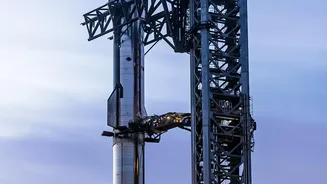

SpaceX is preparing for the next flight of Starship, the most powerful rocket ever built. The ambitious mission, set for as early as November 14 IST, will see the vehicle circle the globe, with its orbital path taking it high above India.
What Exactly is Starship?
Starship is SpaceX's
next-generation, fully reusable space transportation system, designed to carry crew and cargo to Earth orbit, the Moon, and eventually Mars. Standing taller than any rocket in history, its goal is to drastically reduce the cost of space travel, enabling ambitious projects like building a moon base and interplanetary travel for up to 100 people at a time. The system consists of two parts: a massive first-stage booster called Super Heavy and the upper-stage spacecraft, which is also named Starship. Both are designed to return to Earth and be used again, a key factor in making spaceflight more affordable and frequent.
The Next Major Test: Flight 15
The upcoming mission, known as Starship Flight 15, is scheduled to launch from SpaceX's Starbase facility in Texas. Pending final regulatory approval, the launch window opens on November 13 in the US, which corresponds to early November 14 in India Standard Time. This flight is particularly ambitious. For the first time, SpaceX will attempt to recover both the Super Heavy booster and the Starship spacecraft by 'catching' them with the giant mechanical arms of the launch tower. A successful double-catch would be a monumental step towards a fully reusable launch system.
A High-Altitude Path Over India
The mission plan involves Starship reaching an altitude of about 275 kilometres and orbiting the Earth approximately 14 times over more than 22 hours. Due to the nature of orbital mechanics, its path will repeatedly take it over various parts of the globe, including the Indian subcontinent. This will not be a low-altitude flyover like an airplane; Starship will be moving at orbital velocity, thousands of kilometres per hour, far above the atmosphere. While it might be possible for dedicated skywatchers in dark, clear skies to spot it as a fast-moving point of light at certain times, it will primarily be tracked online. The flight path is a consequence of its orbital inclination and extended duration, making passes over India a natural part of its journey around the planet.
Mission Goals and Indian Ocean Splashdowns
The primary goals for Flight 15 are to achieve orbit, deploy a batch of 26 next generation Starlink V3 internet satellites, and successfully test the groundbreaking return and catch maneuvers. The Indian Ocean has been a key location for previous Starship test flights, often serving as the designated area for the spacecraft to perform a controlled splashdown at the end of its mission. Several earlier prototypes have successfully splashed down in the Indian Ocean, allowing engineers to gather crucial data on the vehicle's performance during atmospheric reentry. Although the primary plan for Flight 15 is to return to the launch site, the Indian Ocean remains a contingency landing zone if issues arise.
Why This Matters for Global Spaceflight
Each Starship test flight, successful or not, provides invaluable data that pushes the boundaries of rocket technology. A successful Flight 15, especially with the recovery of both stages, would validate SpaceX's design and accelerate its operational timeline. This has massive implications for the entire space industry, promising much cheaper and more frequent access to orbit. For India's own thriving space program and burgeoning private space sector, the evolution of Starship represents both a new standard of competition and a potential future platform. As launch costs plummet, it could open up new opportunities for Indian scientists, startups, and ISRO to send their own payloads and experiments to space more affordably than ever before.